Train Dreams — Missing It, Riding It, Not Knowing the Stop
Trains run on fixed tracks and fixed schedules. That constraint is the meaning. Plus the numbers our letter rule produces.
A car goes where you steer it. A train goes where the track goes, when the timetable says. That is the entire difference, and it is the whole reading.
A path someone else laid
Trains stand for a course you are on but did not design — an institution, a career track, a set of expectations, a plan agreed with other people.
Being on one is not bad. Most useful things in life run on infrastructure somebody else built. The dream is reporting on your relationship to that fact.
Situation by situation
Missing the train. The most reported version by a distance. It reads as time pressure far more often than as a genuinely missed opportunity — and the honest first move is to look at your actual calendar rather than your psyche.
Running for it and making it. Managing, narrowly. The strain is the content.
On board and content. The track suits you. Nothing more to read.
On board and unable to get off. A course that no longer fits and cannot easily be exited. Common in long tenures.
Not knowing which stop is yours. You are progressing without a defined endpoint. Frequently reported by people several years into something they entered without deciding to.
The wrong train. Realizing the course is not the one you wanted. Worth taking seriously rather than symbolically.
An empty train. Moving through a stage without company.
Watching one leave without you. Something concluded without your participation.
Where the image is heavier
In Japan the train is not merely transport — it is the daily structure of enormous numbers of lives, timed to the minute. Being late is a social fact there in a way it is not everywhere.
An English-language train dream is usually about direction. A Japanese one carries an extra layer of punctuality as obligation, which is worth knowing if the anxiety in your dream felt disproportionate to the stakes.
In Korea, Japan and Taiwan
The train is not an equally loaded object everywhere, and Japan is an outlier by a distance.
Japan. Trains run the country. Punctuality is measured in seconds, a delay of five minutes produces a printed certificate you can hand to your employer, and the last train of the night is a fixed social deadline that ends evenings. Commuting is a defined life stage with its own vocabulary — the packed rush-hour carriage has a name. A train dream in Japan is far more likely to be about the schedule than about the journey.
Taiwan. The train carries history rather than routine. The round-island line was built under Japanese rule, and the slow local trains are a nostalgia object; the high-speed line that replaced them for business travel is barely twenty years old. Riding the old line is something people do deliberately.
Korea. The unfinished piece matters most. Lines run north and stop at the border. The image of a track that continues but cannot be travelled is present in Korean public life in a way it simply is not elsewhere.
A schedule, a memory, a line that stops. English mostly has the track someone else laid.
The numbers
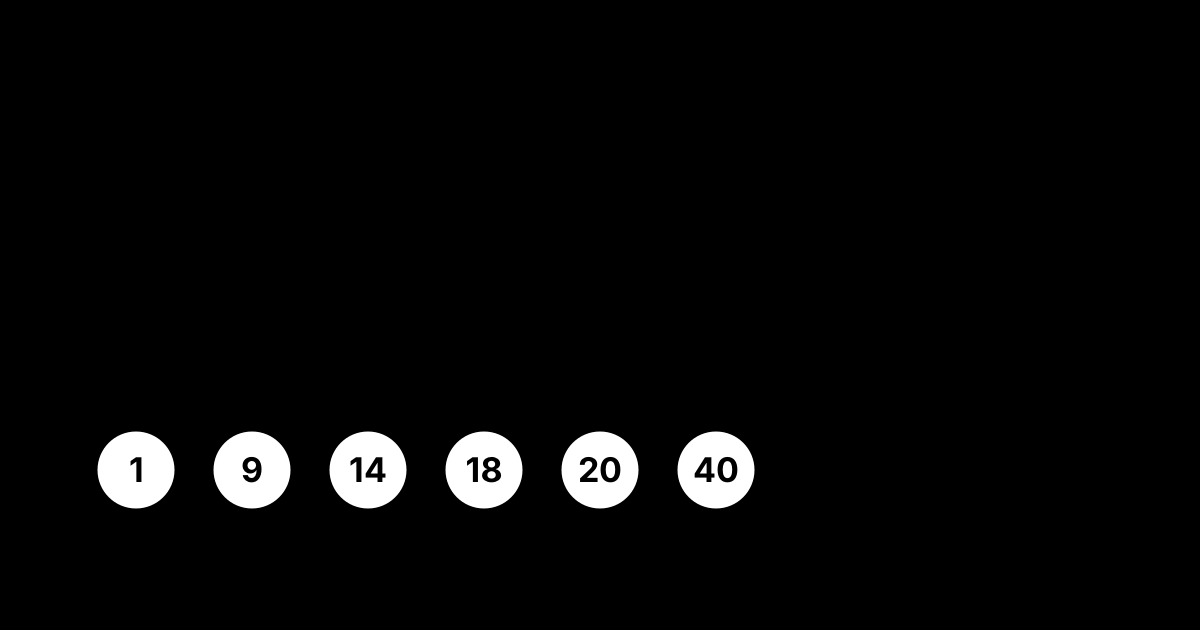
“train” → T=20, R=18, A=1, I=9, N=14
- 1, 9, 14, 18, 20, 40
Five letters, plus 40 from doubling 20.
Among these six, 40 has come up 130 times and 20 has come up 113 times across 1,702 recorded Powerball draws. A record of past draws, not a forecast.
The counts below record actual Powerball draws — a record of the past.
Numbers from this dream
- 1
- 9
- 14
- 18
- 20
- 40
How often these numbers have been drawn
Counts compiled from actual draw results.
Powerball
Compiled from 1,702 draws up to draw 2090. Counts cover main numbers only; the Powerball is tracked separately.
| Number | Times drawn | Share |
|---|---|---|
| 1 | 116 | |
| 9 | 125 | |
| 14 | 123 | |
| 18 | 126 | |
| 20 | 113 | |
| 40 | 130 |
Latest draw 2090 · September 7, 2026
- 15
- 19
- 28
- 39
- 56
- 3
Common questions
What does missing a train mean?
It is one of the most commonly reported dreams anywhere, which makes it a poor candidate for a personal message. What tends to carry meaning is what you did next — waited, gave up, or ran alongside it.
Is being on the wrong train different from missing one?
Meaningfully different. Missing a train is about timing; being on the wrong one is about direction, and about how long it took you to notice. The second is the more uncomfortable dream.
Why trains rather than cars?
Because a train goes where the track goes. That is the whole reason the image works — a car dream is about steering, and a train dream is about a route somebody else already decided.
Related dreams
-
 Airplane Dreams — Committed Until It Lands
-
 Book Dreams — Knowledge That Is Not Yours Yet
-
 Car Dreams — Who Is Driving Tells You Everything
-
 Clothes Dreams — Including the One Where You Are Naked
-
 Door Dreams — Open, Locked, or One You Did Not Notice
-
 Hospital Dreams — Admitting You Cannot Handle It Alone