Book Dreams — Knowledge That Is Not Yours Yet
Reading, receiving, blank pages. A book stands for something available to know but not yet known. Plus the numbers our letter rule produces.
A book on a shelf is knowledge that exists and is not yours. You have to open it for that to change. That distinction is what dreams use.
Available, not acquired
A book in a dream points at something you could know and do not yet — a skill, a field, a qualification, someone else’s experience.
That makes book dreams common during study, during career transitions, and during any period where the gap between what you know and what the situation requires has become obvious.
Situation by situation
Reading and following it. Learning is going in. Straightforward.
Reading and absorbing nothing. The words are there and not landing. Common during periods of overload, when input exceeds capacity to process it.
Being given a book. Instruction or opportunity arriving. If you remember who handed it over, that is the direction.
Blank pages, or text that will not resolve. You do not know what is being asked of you. This one clusters around work with unclear standards.
Losing a book. Something learned slipping away — though it also reads as pruning what you no longer need.
Stacks of unread books. The size of what is outstanding. If it felt oppressive in the dream, that feeling is the content.
Closing a book. Finishing a stage. Read well.
A note on the stakes elsewhere
In Korea, books carried weight that is hard to overstate. The civil service examination was for centuries almost the only route by which a person could change their social position, and books were the door to it. Keeping books visible in a room was itself a statement of standing.
That history is still in the symbol. A Korean book dream leans harder toward qualification and advancement than an English one, which tends toward curiosity and self-improvement.
In Korea, Japan and Taiwan
Books carry an exam attached to them across East Asia, and that changes the dream.
Korea. The image behind the book is gosam — the exam year. The college entrance exam runs one day nationwide, planes are held on the ground for the listening section, and the whole country arranges itself around it. A book dream in Korea often lands near being tested, not near learning. Older still is the gwageo, the civil service examination that decided a family’s standing for generations.
Japan. The parallel is juken, and the object attached to it is the omamori charm bought at a shrine for exam success — Tenjin shrines specialise in it. Japan also gives books a physical ritual English lacks: the bookshop wraps every purchase in a paper cover so nobody on the train can see what you are reading. Reading is semi-private there.
Taiwan. Same exam pressure, plus the temple layer — students leave their exam admission tickets at Wenchang Dijun temples, the deity of literature and examinations, and the tables fill up before the test.
In English a book in a dream is mostly knowledge or escape. In all three of these it is frequently a test you have not sat yet.
The numbers
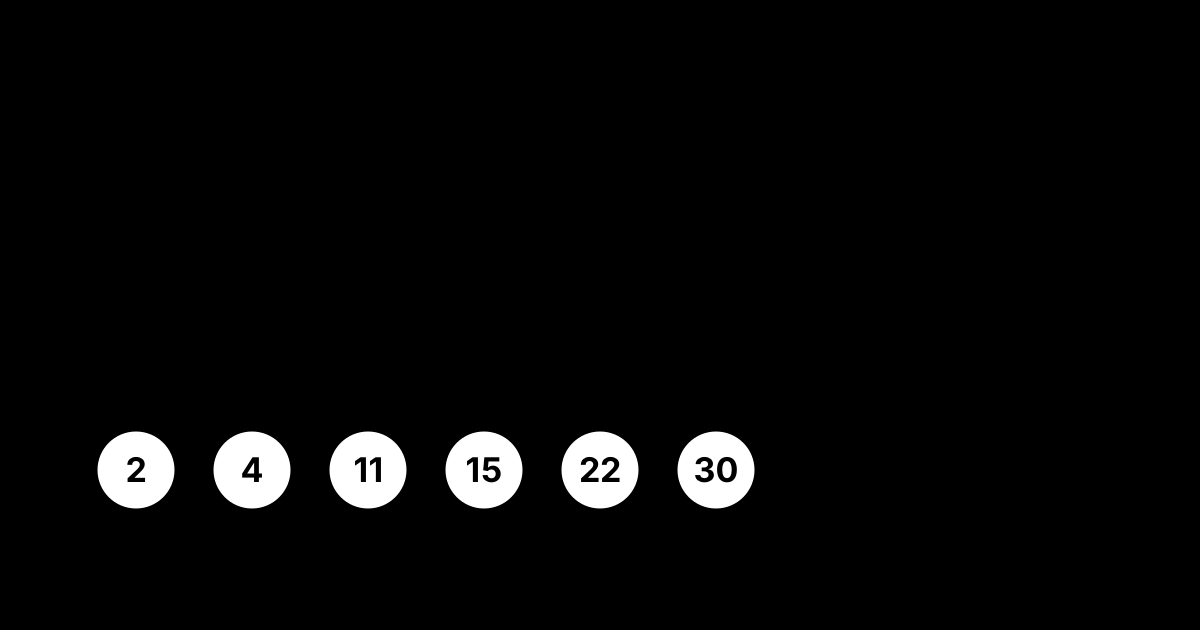
“book” → B=2, O=15, O=15, K=11
- 2, 4, 11, 15, 22, 30
The doubled O collapses to three distinct letters; 4, 22 and 30 come from doubling.
Among these six, 2 has come up 131 times and 4 has come up 116 times across 1,702 recorded Powerball draws. A record of the past, not a prediction.
The counts below record actual Powerball draws — history only.
Numbers from this dream
- 2
- 4
- 11
- 15
- 22
- 30
How often these numbers have been drawn
Counts compiled from actual draw results.
Powerball
Compiled from 1,702 draws up to draw 2090. Counts cover main numbers only; the Powerball is tracked separately.
| Number | Times drawn | Share |
|---|---|---|
| 2 | 131 | |
| 4 | 116 | |
| 11 | 127 | |
| 15 | 118 | |
| 22 | 118 | |
| 30 | 126 |
Latest draw 2090 · September 7, 2026
- 15
- 19
- 28
- 39
- 56
- 3
Common questions
What does it mean to dream of a book you cannot read?
One of the most commonly reported versions. The text swimming, shifting, or being in an unknown script is a very ordinary feature of dreaming — reading is one of the things dreams handle badly. It is usually about the effort rather than about the content.
Does an open book mean something different from a closed one?
Yes, and it is the most useful split. An open book is available; a closed one is held back. Which of the two you were looking at often says more than the title did.
I dreamt of losing a book. Is that bad?
Read it as access rather than loss. A book is a thing you can replace, so the dream tends to point at something you were relying on being there rather than at the object itself.
Related dreams
-
 Airplane Dreams — Committed Until It Lands
-
 Car Dreams — Who Is Driving Tells You Everything
-
 Clothes Dreams — Including the One Where You Are Naked
-
 Door Dreams — Open, Locked, or One You Did Not Notice
-
 Hospital Dreams — Admitting You Cannot Handle It Alone
-
 House Dreams — Rooms You Did Not Know Were There