Clothes Dreams — Including the One Where You Are Naked
Clothes are the version of yourself other people see. New clothes, the wrong size, and the naked-in-public dream everybody has.
Clothes sit closest to the body and are the part everyone else sees. That double position is what dreams use them for.
The presented self
Clothes stand for the version of you that is visible — role, standing, the impression you are currently making. If shoes are the ground you stand on, clothes are the part people read.
English keeps the association without noticing: dressed for the job you want, all mouth and no trousers, wearing many hats.
Situation by situation
New clothes. Entering a role. Comfortable and well-fitting means the role suits you.
Clothes that do not fit. Misalignment. Too large is responsibility beyond your current footing; too small is capability with nowhere to go.
Dirty or torn clothes. Reputation taking damage. Washing or mending them flips it to recovery.
Taking clothes off. Setting a role down. Relief in the dream reads well.
Someone else’s clothes. Occupying a position that is not yours.
The naked dream
This deserves its own section, because almost everybody has it and almost nobody discusses it.
Standing exposed in front of people reads as fear of being seen unprepared rather than fear of exposure as such. It clusters around new jobs, presentations, and any situation where you are about to be assessed.
The detail worth recalling is whether anyone noticed. In a large share of reports, nobody in the dream reacted at all — which is usually also true of the waking situation.
What is heavier elsewhere
In Japan and Korea, what you wear has historically encoded rank and occasion far more explicitly than in English-speaking countries. Formal wear for ceremonies is prescribed rather than chosen, and school and workplace uniforms remain standard.
That makes the “wrong clothes” dream sharper there. Wearing the wrong thing is not a style error but a failure to read your position correctly — which is why the same dream lands harder in Seoul or Tokyo than it does in Chicago.
In Korea, Japan and Taiwan
Clothing carries more explicit rules in all three, which gives the dream more to work with.
Japan. There is a right thing to wear and everyone knows what it is. Recruit suits are near-identical black suits worn by every job-hunting student. The kimono’s left-over-right fold is fixed — the reverse is used only to dress the dead, which makes it a genuine taboo. So a dream of being dressed slightly wrong is sharper in Japan than a dream of being dressed badly.
Korea. Hanbok is now ceremonial, worn at holidays and weddings, so it arrives in a dream already meaning family and occasion. Separately, everyday appearance carries real social weight, and the pressure to be presentable is discussed openly rather than assumed.
Taiwan. The strongest rule is about colour. White is the funeral colour, and giving someone white clothing or wrapping a gift in white reads as a death reference. Red is for weddings and new year.
An exact standard, an occasion, a colour code. In English clothes are mostly self-expression.
The numbers
“clothes” → C=3, L=12, O=15, T=20, H=8, E=5
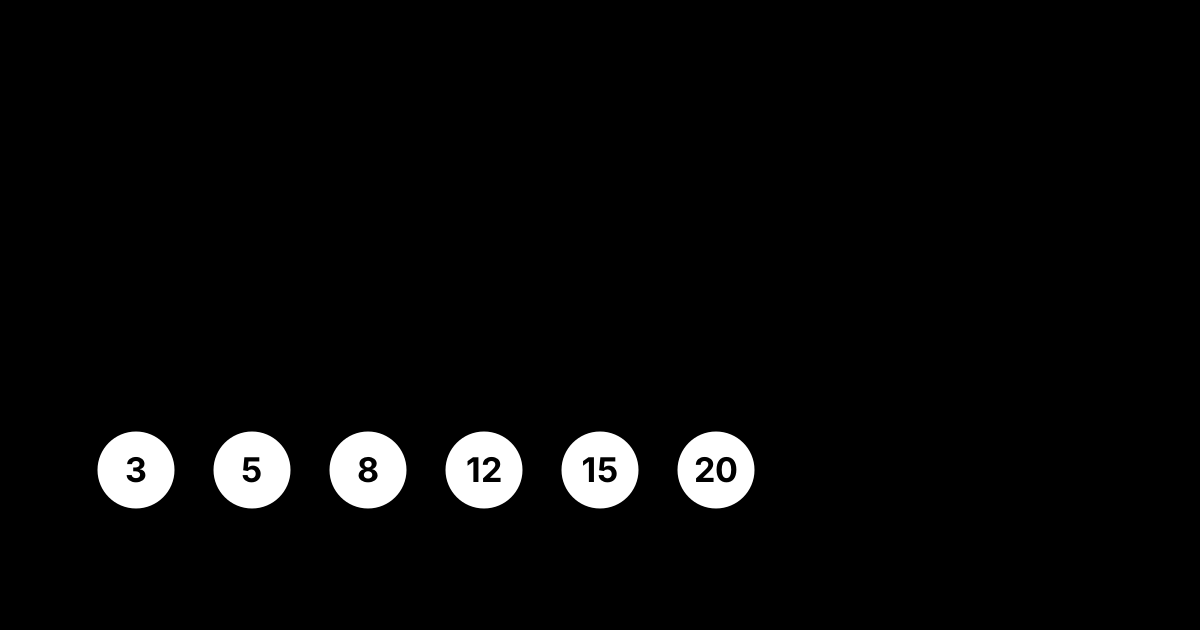
- 3, 5, 8, 12, 15, 20
Six distinct letters taken in order.
Among these six, 3 has come up 138 times and 20 has come up 113 times across 1,702 recorded Powerball draws. Every draw is independent, and no number is ever due.
The counts below record actual Powerball draws — history, not forecast.
Numbers from this dream
- 3
- 5
- 8
- 12
- 15
- 20
How often these numbers have been drawn
Counts compiled from actual draw results.
Powerball
Compiled from 1,702 draws up to draw 2090. Counts cover main numbers only; the Powerball is tracked separately.
| Number | Times drawn | Share |
|---|---|---|
| 3 | 138 | |
| 5 | 118 | |
| 8 | 129 | |
| 12 | 133 | |
| 15 | 118 | |
| 20 | 113 |
Latest draw 2090 · September 7, 2026
- 15
- 19
- 28
- 39
- 56
- 3
Common questions
Why is the naked dream so common?
Because it works on something universal — the gap between how you are seen and how you feel. It is one of the most widely reported dream types worldwide, which is exactly why it is unlikely to be a personal message.
What does wearing the wrong clothes mean?
Read it by who noticed. Wrong clothes with nobody looking and wrong clothes in front of a crowd are different dreams. The second is about judgment, the first usually about your own standards.
Does the colour matter?
It can matter a great deal, but the meaning is local rather than universal. White in particular reads as a wedding in English-speaking countries and as mourning across much of East Asia, so the same dress means opposite things.