Dreams About Strangers — The Faceless Person
The person you do not recognize is usually a part of yourself you have not named. What the faceless figure signals, plus our letter-rule numbers.

There is a specific figure that turns up in a lot of dreams: a person who is definitely someone, whose face you cannot quite hold onto.
Your brain does not invent faces
Worth knowing, because it changes how you read this. The prevailing view is that dreams do not generate faces from nothing — they reuse faces you have seen, including ones you never consciously registered. The stranger in your dream is statistically likely to be someone you passed on a platform once.
That does not make them meaningful as a person. It means the face is filler. The role they played is the content.
What the role tends to be
Jung’s term for it was the shadow — the part of yourself that has not been acknowledged, showing up as someone else because you do not recognize it as yours.
You do not need the whole framework to use the idea. Ask what the stranger did in the dream, then ask whether you have done or wanted that.
A stranger who threatens you. Something in you that you are treating as an enemy — anger, ambition, a need.
A stranger who helps you. A capability you have not credited yourself with.
A stranger who ignores you. A part of your life that is not getting attention.
A stranger you feel you know. The recognition is the signal. Something familiar wearing an unfamiliar face.
A crowd of strangers. The general pressure of being observed. Common before public-facing events.
When the face never resolves
The version people find most unsettling is the one where you keep looking and the face refuses to settle. Read it plainly: something is unresolved and has not been given a name yet. The dream is not withholding an answer — the answer has not been formed.
In Korea, Japan and Taiwan
Who counts as a stranger is not the same everywhere, and that changes the dream.
Japan. The organising split is uchi and soto, inside and outside. It is built into the grammar — the polite forms you use mark whether someone is in your group. A stranger in a Japanese dream is not a blank; they are explicitly outside, and the discomfort of a stranger behaving as if they were inside is a specific, recognisable unease.
Korea. Age and relation come first. The language has no comfortable neutral form of address, so meeting someone unplaceable is genuinely awkward — you cannot speak until you know. A faceless stranger in a Korean dream carries that unresolvable question with it.
Taiwan. The temple layer adds something English has no equivalent for. During the seventh lunar month, an unfamiliar figure may be read as one of the hao xiong di — the wandering dead who are addressed politely rather than driven off. A stranger can be someone to be courteous to, not someone to fear.
Outside the line, unplaceable, or possibly not living. English mostly just says “unknown”.
The numbers
“stranger” → S=19, T=20, R=18, A=1, N=14, G=7
- 1, 7, 14, 18, 19, 20
Six distinct letters taken in order; the trailing letters are not needed.
Among these six, 19 has come up 131 times and 20 has come up 113 times across 1,702 recorded Powerball draws. A record of past draws, not a forecast.
The counts below record actual Powerball draws — a record of the past only.
Numbers from this dream
- 1
- 7
- 14
- 18
- 19
- 20
How often these numbers have been drawn
Counts compiled from actual draw results.
Powerball
Compiled from 1,702 draws up to draw 2090. Counts cover main numbers only; the Powerball is tracked separately.
| Number | Times drawn | Share |
|---|---|---|
| 1 | 116 | |
| 7 | 120 | |
| 14 | 123 | |
| 18 | 126 | |
| 19 | 131 | |
| 20 | 113 |
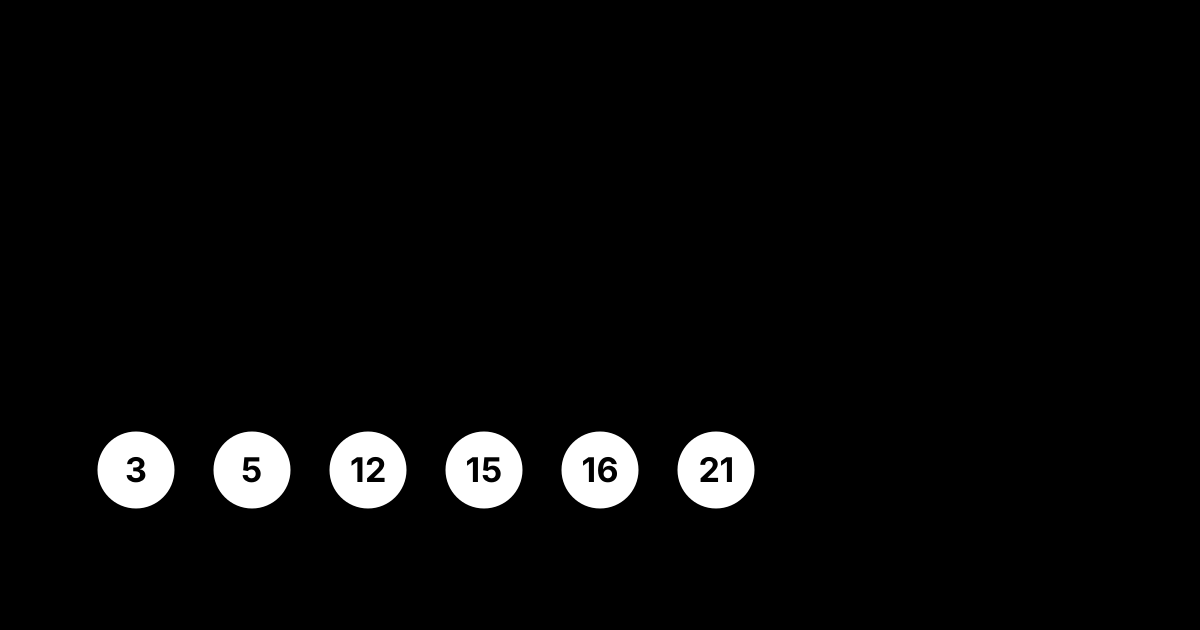
Latest draw 2090 · September 7, 2026
- 15
- 19
- 28
- 39
- 56
- 3
Common questions
Do dream faces really come from people I have seen?
That is the commonly repeated claim, and the honest position is that it is plausible but not settled. What is better established is that faces in dreams are often unstable — they shift, or you know who someone is without their face matching. Treat the identity as loose rather than as evidence.
What if the stranger felt familiar?
Very common, and the feeling of familiarity is generated separately from the face. Follow the feeling rather than trying to work out who it was; the recognition is usually about a role or a situation rather than a specific person.
Is a threatening stranger a warning?
Usually it is closer to something unresolved than to a prediction. What tends to carry the meaning is whether you confronted them, avoided them, or could not move at all.
Related dreams
-
 Dreams of Dead Relatives — A Visit, or a Haunting?
-
 Dreams About Babies — New Things, Not Necessarily Children
-
 Celebrity Dreams — The Role, Not the Person
-
 Couple Dreams — Watching a Partnership From Outside
-
 Deity Dreams — Being Addressed by Something Larger
-
 Dreams About Friends — Usually About Who You Were Then