Door Dreams — Open, Locked, or One You Did Not Notice
A door is a decision point rendered as architecture. What open, locked and unfamiliar doors each signal, plus our letter-rule numbers.
A door is the only piece of architecture whose entire purpose is to be a decision. Open or closed, through or not.
The threshold
Doors in dreams mark transitions you are aware of. That awareness is the distinguishing feature — a wall is something you cannot pass, a door is something you have not passed yet.
The related symbol is keys, which is about access. Doors are about the decision. You can have the key and still not go through.
Situation by situation
An open door. Something available. Whether you went through it in the dream is the substantive detail — a lot of people report standing in front of one and doing nothing.
A locked door. Access denied, or denied to yourself. Did you try the handle? People frequently report they did not.
A door you cannot close. Something you want to end that will not end. Reported during drawn-out separations and unresolved disputes.
A door where there was no door before. An option that has appeared. Often reported in the weeks after a significant change.
Many doors. Too many options, or a decision with more branches than you can hold.
A revolving door. Motion without progress. The image is almost too on-the-nose, and people report it anyway.
Someone at the door. Something arriving that you have to decide whether to admit.
The room on the other side
If you remember what was through it, that is the more specific reading. A familiar room means a known consequence. An unfamiliar one means the decision leads somewhere you cannot yet picture — which is not a reason not to open it.
The same threshold elsewhere
In Korea, the gate carried the household’s standing. Traditional homes marked status in the size and style of the main gate, and the phrase the threshold is high still means a place is hard to get into. So a Korean door dream leans toward being accepted rather than toward opportunity — being let through means being recognized.
In Japan, the reading stays on the boundary itself. A door separates here from there, and what matters is which side you were standing on. The weight of family status is not attached.
In English, the door is opportunity, almost entirely. When one door closes, another opens is ordinary speech. There is a second layer too — the gatekeeper — which asks who holds the authority to let you through.
Standing, boundary, opportunity.
The numbers
“door” → D=4, O=15, O=15, R=18
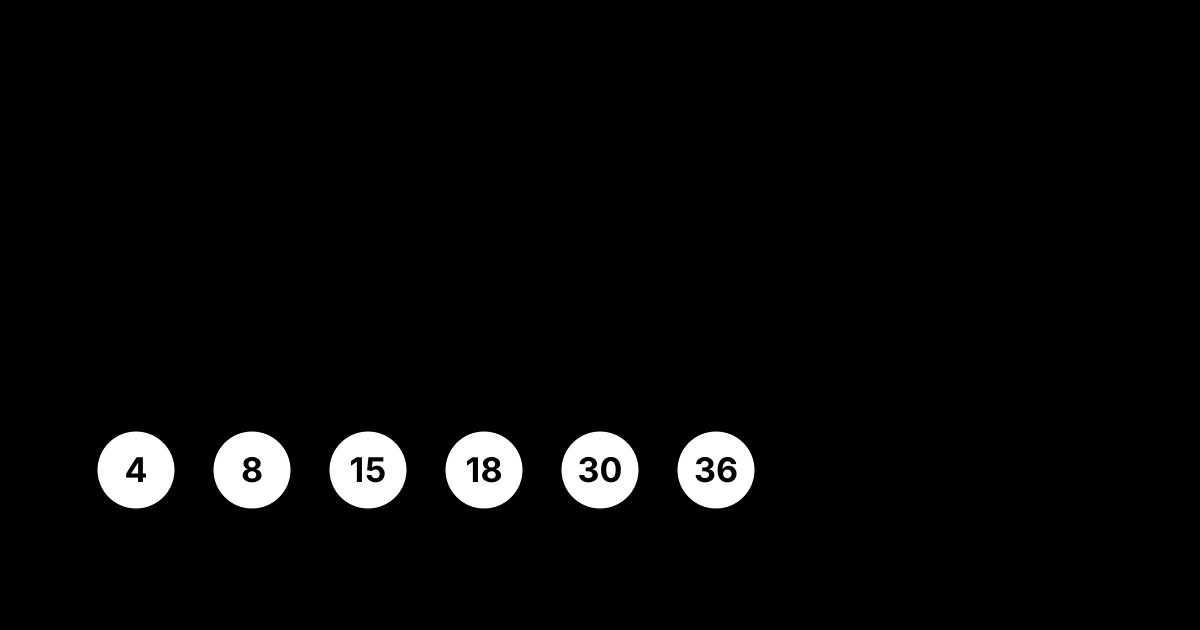
- 4, 8, 15, 18, 30, 36
The doubled O collapses; 8, 30 and 36 come from doubling.
Of these six, 36 has come up 142 times across the 1,689 recorded Powerball draws in our data and 4 has come up 116 times. Neither is more likely next time.
The counts below are historical Powerball records and predict nothing.
Numbers from this dream
- 4
- 8
- 15
- 18
- 30
- 36
How often these numbers have been drawn
Counts compiled from actual draw results.
Powerball
Compiled from 1,702 draws up to draw 2090. Counts cover main numbers only; the Powerball is tracked separately.
| Number | Times drawn | Share |
|---|---|---|
| 4 | 116 | |
| 8 | 129 | |
| 15 | 118 | |
| 18 | 126 | |
| 30 | 126 | |
| 36 | 142 |
Latest draw 2090 · September 7, 2026
- 15
- 19
- 28
- 39
- 56
- 3
Common questions
What does a door that will not open mean?
One of the most reported versions. It generally reads as **the method being wrong** rather than the goal — pushing when it pulls, or a key that does not fit. It tends to show up when effort is being repeated without being adjusted.
Is a closed door a bad sign?
Not by itself. A closed door reads as a stage that has not opened yet; a locked one as conditions not yet met. Whether you were on the inside or the outside changes the reading more than open-versus-shut does.
What if someone opened the door for me?
A good version, and in Korean interpretation a notably strong one. Being let through carries a sense of being recognized, because the gate of a house historically signalled the household's standing. If you remember who opened it, that person is part of the reading.