Thief Dreams — Why East Asia Reads These as Lucky
Being robbed is alarming to wake from and is treated as fortunate in Korean and Japanese tradition. The reasoning is more sensible than it sounds.
You wake from a break-in dream with your heart going, look it up, and find that half the internet says it is good news. The disagreement is real, and it is cultural.
The English reading
English-language interpretation takes this one fairly literally. A thief points at something being taken — security, autonomy, credit for work, time. The intruder is a violation, and the dream is about vulnerability.
That is a reasonable reading and it fits how the dream feels.
The East Asian reading
Korean and Japanese interpretation both treat the burglar dream as favorable, and the logic is worth following because it is not simply contrarian.
A thief enters a house that has something in it. Nobody breaks into an empty house. So the burglary is evidence that there is something there worth taking — which reads as a report on your assets rather than on your losses.
That sits inside a wider pattern in both traditions: dreams of loss get inverted. Losing, burning, dying and being robbed all read as clearing that makes room. The death dream and fire dream entries follow the same logic.
Neither reading is wrong. They are answering different questions — English asks how you felt, Korean asks what it implies about the house.
Situation by situation
A break-in. The fact of entry is the signal in the East Asian reading; the loss is the signal in the English one.
Something specific stolen. Read the object. Money, shoes, a ring — each carries its own meaning, and the theft modifies it.
Catching the thief. Two ways: a problem resolved, or something incoming being blocked. Whether you felt relief or regret decides it.
Meeting the thief face to face. Something avoided, now encountered directly.
Being the thief. Read separately. A method you would not endorse has crossed your mind, or you want something that belongs to someone else.
A thief who takes nothing. A near miss survived.
One practical note
If this dream recurs, it can indicate real pressure to protect something — a position, a relationship, savings. Worth checking that before filing it under lucky.
In Korea, Japan and Taiwan
The dream turns on where the boundary of the home is, and that is built differently.
Japan. The traditional house barely locks — sliding paper and wood doors separate rooms without sealing them, and the working boundary is the genkan step where shoes come off. Crime rates are low enough that unlocked doors were normal within living memory. So a break-in dream in Japan reads as something crossing a line that is social rather than physical.
Korea. The reading tilts the other way. Dodukkkum — the thief dream — is sometimes read as money arriving, on the logic that something entered the house. It is not the strongest of the lucky dreams there (the pig, the feces and the ancestor rank higher) but the association is real and people act on it.
Taiwan. The door itself is defended. Menshen — door gods painted on temple and house doors — are guardians, and the bagua mirror above a doorway deflects what should not enter. A break-in dream can read as the guard having failed.
A social line, money arriving, a guardian that failed. English has only the crime.
The numbers
“thief” → T=20, H=8, I=9, E=5, F=6
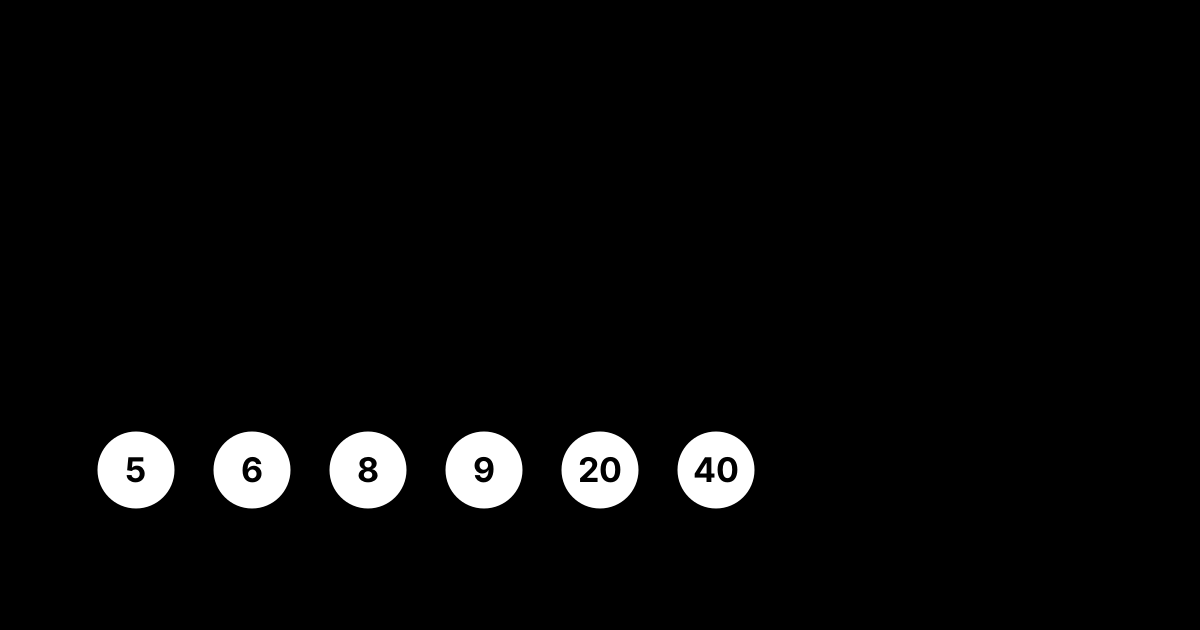
- 5, 6, 8, 9, 20, 40
Five letters, plus 40 from doubling 20.
Among these six, 6 has come up 132 times and 20 has come up 113 times across 1,702 recorded Powerball draws. A record of past draws, not a forecast.
The counts below record actual Powerball draws. No dream changes the odds of a draw.
Numbers from this dream
- 5
- 6
- 8
- 9
- 20
- 40
How often these numbers have been drawn
Counts compiled from actual draw results.
Powerball
Compiled from 1,702 draws up to draw 2090. Counts cover main numbers only; the Powerball is tracked separately.
| Number | Times drawn | Share |
|---|---|---|
| 5 | 118 | |
| 6 | 132 | |
| 8 | 129 | |
| 9 | 125 | |
| 20 | 113 | |
| 40 | 130 |
Latest draw 2090 · September 7, 2026
- 15
- 19
- 28
- 39
- 56
- 3
Common questions
Is being robbed in a dream a warning?
Rarely. What tends to carry the meaning is what was taken and when you noticed. A theft you discovered afterwards and one you watched happen are different dreams.
What if I was the one stealing?
It usually points at something you want but do not feel entitled to ask for directly. Whether you hesitated is the useful detail, more than what you took.
I could not tell what was missing.
Common, and the vagueness is the content. If the feeling that remained was about being entered rather than about the object, read it as a boundary dream instead.