Fire Dreams — Why the Frightening Ones Often Read Well
A house burning is alarming to wake from and unusually constructive to interpret. What the flame, the smoke and your own role each mean. Plus the numbers.
You wake up with your heart going. The house was burning, or the room was, and you could feel the heat of it.
Then you look up what it means and find that fire dreams are usually read as positive, which does not match the feeling at all. Here is why the gap exists.
Fire destroys and fire rises
Interpretation traditions consistently pick up on the second half. Flame moves upward. It is the most direct image of energy going somewhere, and English carries that reading in its ordinary idioms — things sell like wildfire, a project catches fire, someone is fired up.
So a fire dream is generally read as a report of force in motion. Something has energy behind it. What burns is usually a structure that had outlived itself.
That does not make the dream pleasant. It only means the fear you woke with is not the message.
How it burned
Large, bright, climbing. The strongest version. High flame, clear color, plenty of it. Read as momentum.
A house on fire. Alarming and generally read well — the frame of a life changing shape. It clusters around moves, separations, and career changes.
You set it. You are the one changing the situation. Agency rather than circumstance.
You put it out. The reverse. Something was starting and you stopped it. Sometimes that is exactly right — there may be something worth protecting — but it is worth knowing that is what the dream recorded.
Smoke with no visible flame. The one genuinely cautionary version. Smoke obscures. It reads as moving forward without being able to see the situation. If you woke from a smoke dream, the useful question is what you are proceeding on without confirming.
A small fire going out. Depletion. Something is being carried on willpower alone.
Fire in the dream book tradition
Fire appeared in every American dream book — those pocket guides sold from the 1800s into the mid-twentieth century that listed dream symbols beside numbers for the street numbers game. The pairing of dream and number is old and specifically American, and it is why pages like this one exist.
We do not reproduce their entries. The books contradicted each other and none carried real authority. Ours come from a rule you can run yourself.
The numbers
Letters become alphabet positions; multiples fill out the set, wrapped into range.
“fire” → F=6, I=9, R=18, E=5
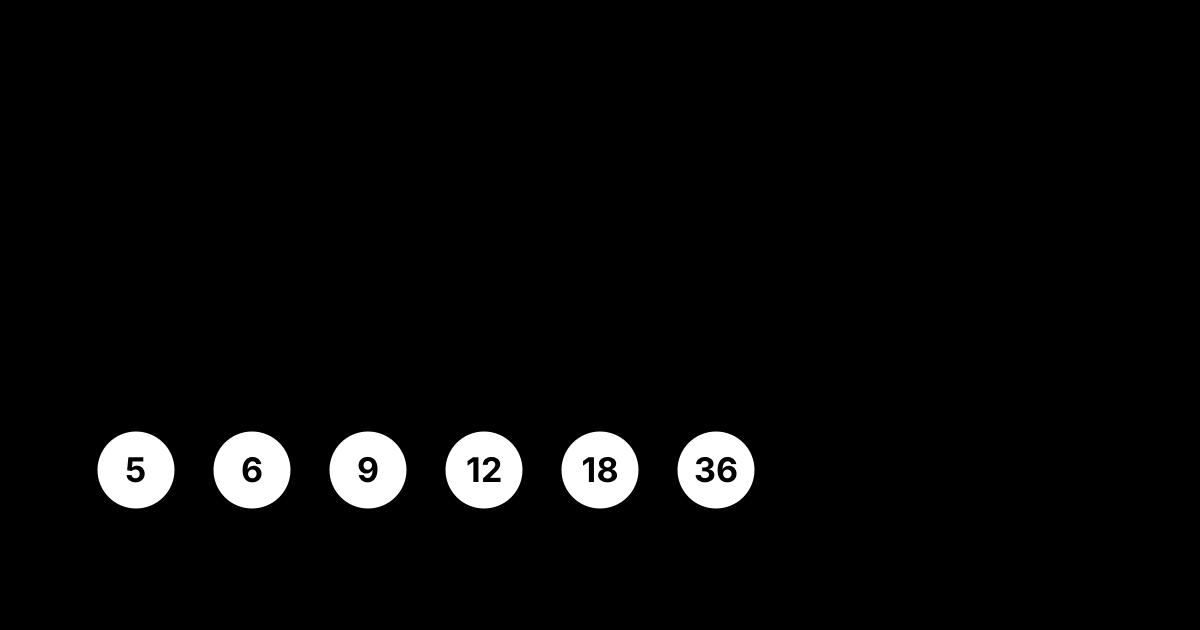
- 5, 6, 9, 12, 18, 36
Four letters give four numbers. Twelve is six doubled and thirty-six is eighteen doubled. Nothing here is chosen by taste.
Of these six, 36 has appeared 142 times across the 1,689 recorded Powerball draws in our data and 5 has appeared 118 times. That says nothing about the next draw.
The counts below record actual Powerball draws. They are a description of the past, not a signal about the next one. Fire’s association with fortune is a fact about language and folklore, not about probability.
Numbers from this dream
- 5
- 6
- 9
- 12
- 18
- 36
How often these numbers have been drawn
Counts compiled from actual draw results.
Powerball
Compiled from 1,702 draws up to draw 2090. Counts cover main numbers only; the Powerball is tracked separately.
| Number | Times drawn | Share |
|---|---|---|
| 5 | 118 | |
| 6 | 132 | |
| 9 | 125 | |
| 12 | 133 | |
| 18 | 126 | |
| 36 | 142 |
Latest draw 2090 · September 7, 2026
- 15
- 19
- 28
- 39
- 56
- 3
Common questions
Is a fire dream a bad omen?
In English, largely yes — fire reads as destruction and the idioms follow, from playing with fire to burnout. In Japan and Korea it is one of the best-known good dreams, with rising flames read as fortune gaining momentum. This is one of the widest gaps between the traditions on this site.
My house was burning. What does that mean?
The English reading is strain on your foundations. Korean and Japanese interpretation both contain a strand where an old structure burning so a new one can stand is favourable. What happened after the fire, if you remember it, decides which reading fits.
What about smoke without flames?
Treated as the cautionary version in Japanese interpretation specifically. Smoke obscures rather than transforms, so it reads as proceeding without being able to see — a shortage of information rather than a shortage of energy.