Dreams About Death — Almost Never About Dying
Why interpreters read death dreams as endings rather than warnings, how the identity of who died changes it, and our letter-rule numbers.
There is no dream people want reassurance about faster than this one. So, first: interpretation traditions almost universally do not read death dreams as being about death. That is not a comforting spin. It is the standard reading, and it has been for a very long time.
Why endings, not deaths
A death in a dream marks a state finishing. Where something ends, something else starts. Interpretation consistently reads the boundary rather than the loss.
Jung placed these dreams squarely in the territory of transformation — the psyche registering that a version of the self has run its course. In practice they show up around the changes that are large enough to make the previous arrangement unrecoverable: leaving a career, ending a long relationship, becoming a parent, getting sober.
Who died
You did. The strongest and, counterintuitively, the most positive version. The self you have been operating as is closing out. People report it during periods of deliberate change more than during periods of fear.
A family member or partner. Rarely about that person’s safety. It reads as the relationship changing form — a child becoming independent, a parent’s role shifting, a partnership entering a different phase. Ordinary changes, arriving in stark imagery.
Someone already gone. This is a separate category and should be read separately. Most traditions treat it as memory doing work rather than as a message about death. What they said in the dream matters less than how you felt while they were there — that feeling is the part worth keeping.
A stranger. A part of yourself going quiet. A habit, a role, a way of handling things you no longer need.
How it happened
Peacefully, without pain. The transition is one you have already made room for.
Painfully, or with struggle. The change itself may be fine; the logistics and the people around it are the hard part.
Dying and then coming back. The plainest possible image of renewal. Something set aside is not as finished as you assumed.
The dream book background
American dream books, sold from the 1800s through the mid-twentieth century, paired dream symbols with numbers for the street numbers game. Death was a standard entry — the books covered the whole range of ordinary human dreaming, which is exactly why they were useful to people.
We do not reprint those numbers. They varied between publishers and none of them held any real authority. We use a rule that is stated in the open.
The numbers
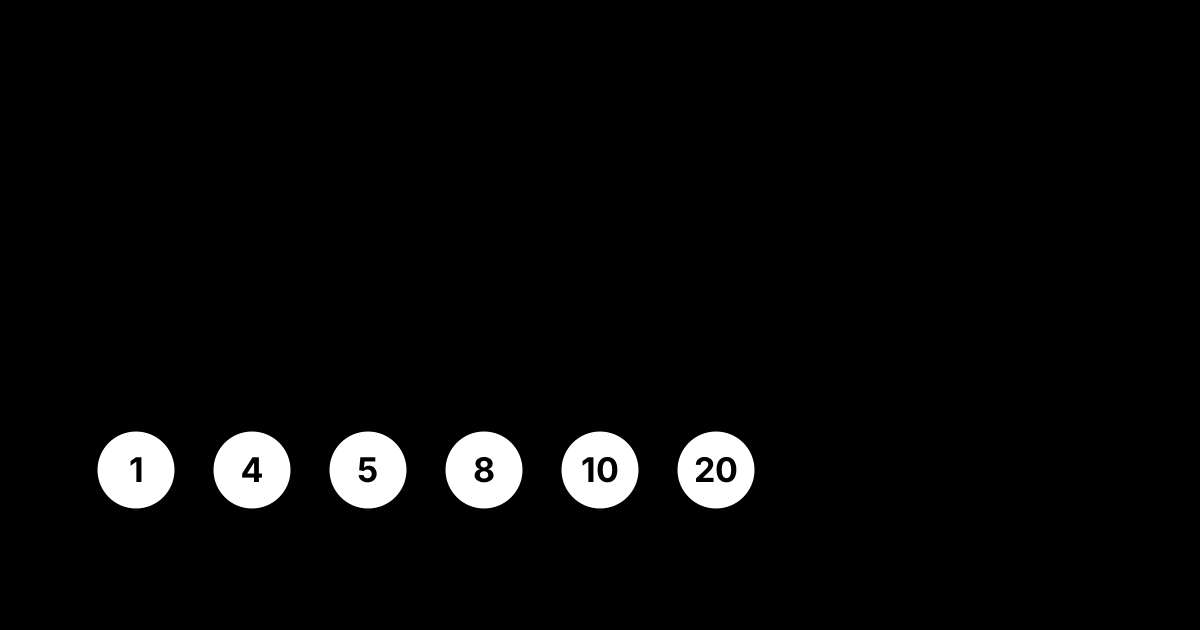
“death” → D=4, E=5, A=1, T=20, H=8
- 1, 4, 5, 8, 10, 20
Five letters give five numbers; 10 is 5 doubled. Everything above is reproducible from the alphabet in under a minute.
Among these six, 8 has come up 129 times across the 1,689 recorded Powerball draws in our data and 20 has come up 113 times. Frequency in the past is not a forecast.
The counts that follow record past Powerball draws. They are not a forecast. And if this dream arrived during a hard stretch rather than a changing one, the thing worth attending to is the stretch, not the numbers.
Numbers from this dream
- 1
- 4
- 5
- 8
- 10
- 20
How often these numbers have been drawn
Counts compiled from actual draw results.
Powerball
Compiled from 1,702 draws up to draw 2090. Counts cover main numbers only; the Powerball is tracked separately.
| Number | Times drawn | Share |
|---|---|---|
| 1 | 116 | |
| 4 | 116 | |
| 5 | 118 | |
| 8 | 129 | |
| 10 | 124 | |
| 20 | 113 |
Latest draw 2090 · September 7, 2026
- 15
- 19
- 28
- 39
- 56
- 3
Common questions
Does dreaming of someone dying mean they are in danger?
It is not read as a prediction anywhere — not in English, Japanese or Korean interpretation. The usual reading is that something in your relationship with that person has concluded or changed shape. Their actual health is a separate matter entirely.
I dreamed of my own death. Is that as bad as it felt?
The reading is better than the feeling. Across all three traditions on this site, dying in a dream is read as one stage ending and another beginning rather than as a threat. In Korean interpretation it is treated as an outright good dream, sometimes discussed alongside lottery luck.
What about someone coming back to life?
Something you considered finished returning. Whether that is welcome depends on what came back. Korean tradition leans positive on this one more readily than English does.