Teeth Falling Out in a Dream — Why It Is So Common
One of the most reported dreams there is. What the research actually says, how the situation changes the reading, plus our letter-rule numbers.
A tooth loosens. You touch it and it comes free. Then another. You wake up running your tongue along the inside of your mouth to check.
Dreams of losing teeth are among the most frequently reported dream types anywhere researchers have looked, across very different cultures. Whatever produces them is not local.
Why this dream in particular
Two explanations get offered, and they are not in conflict.
The psychological one: teeth are permanent in a way almost nothing else about the body is. Lose one and it does not grow back. That makes them an unusually efficient symbol for anything irreversible — aging, a reputation, a decision that cannot be walked back.
The physical one: some sleep researchers connect these dreams to dental tension during sleep, particularly teeth grinding. If you wake with a sore jaw as well as the dream, that is worth noticing on its own terms.
There is also the plain fact that teeth are how we bite and how we speak. Losing them maps neatly onto losing force, or losing the ability to say something.
Which tooth, and how
Front teeth. The ones people see. This version clusters around visibility — new job, new city, a presentation coming up, anything where you are being looked at.
Molars. The chewing teeth, the ones that do unglamorous work. They read as the foundation rather than the image. Income, housing, the arrangements that hold a life up.
All of them at once. Dramatic, and not the disaster it feels like. It reads as a wholesale clearing rather than a loss — a life stage ending all at once instead of piece by piece.
With blood. A change with cost attached. Worth noting that in most traditions blood is also vitality, not only injury.
Painless, sliding out easily. You have already accepted whatever this is about.
Searching for the tooth afterward. Trying to reverse something. The dream is telling you the reversing is not finished.
Loose but not falling. A decision you are still not making.
The dream book connection
In the American dream book tradition — the pocket guides sold from the 1800s onward that paired dream symbols with numbers for the street numbers game — teeth had their own entry, as did nearly every common dream. Those books were part folklore, part practical tool. They are why “what number is that dream” is a question people still ask.
We do not copy their numbers. Different publishers gave different answers and none of them agreed. We use a rule that anyone can verify.
The numbers
Each letter becomes its position in the alphabet; multiples fill out the rest, wrapped into range.
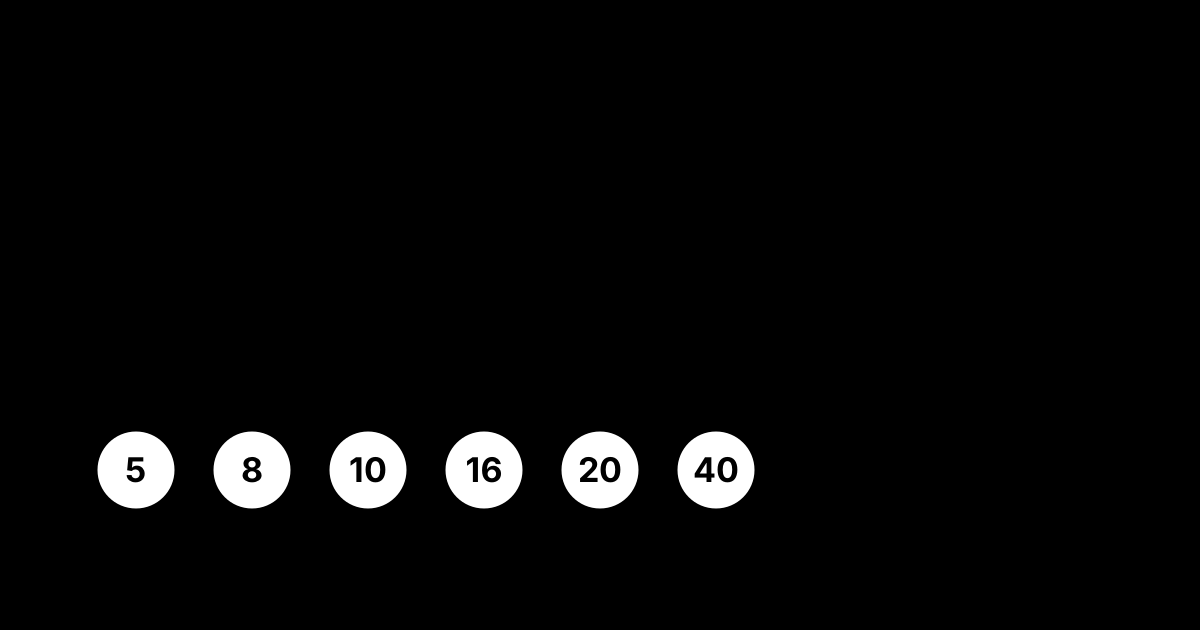
“teeth” → T=20, E=5, E=5, T=20, H=8
- 5, 8, 10, 16, 20, 40
The repeats collapse, so five letters give three distinct starting numbers; 10, 16 and 40 come from doubling. Check it yourself in a minute.
Of these six, 16 has appeared 133 times across the 1,689 recorded Powerball draws in our data and 20 has appeared 113 times. That gap does not predict anything.
The counts below are historical. They record what has been drawn, not what will be. If this dream has you unsettled, the more useful move is to look at where you feel unable to speak up — not to spend money you would rather keep.
Numbers from this dream
- 5
- 8
- 10
- 16
- 20
- 40
How often these numbers have been drawn
Counts compiled from actual draw results.
Powerball
Compiled from 1,702 draws up to draw 2090. Counts cover main numbers only; the Powerball is tracked separately.
| Number | Times drawn | Share |
|---|---|---|
| 5 | 118 | |
| 8 | 129 | |
| 10 | 124 | |
| 16 | 133 | |
| 20 | 113 | |
| 40 | 130 |
Latest draw 2090 · September 7, 2026
- 15
- 19
- 28
- 39
- 56
- 3
Common questions
Why is this dream so common?
It is one of the most frequently reported dreams worldwide, which is itself the most interesting fact about it. A meaningful share of cases appear to track physical causes — jaw clenching, grinding, dental discomfort — rather than symbolism. If you wake with tension in your jaw, start there.
Does it mean someone in my family will die?
That reading exists, but it comes from Korean tradition rather than English-language interpretation, and it is not evidence-based. Korean readings go further still and assign which relative based on which tooth. If the idea has been troubling you, it is worth knowing that it is a specific cultural inheritance and not a general truth about the dream.
Does it matter which tooth it was?
Some traditions say yes — front teeth as the visible self, molars as underlying support. But if you cannot recall which tooth, do not force it. Not remembering usually means that detail was not what the dream was built around.