Dreams About Keys — Access, and Losing It
Keys stand for access rather than possession. Losing them, finding one, holding a key that fits nothing — plus our letter-rule numbers.
A key is a small object with an unusually specific job: it decides whether a door is a door or a wall. Dreams use it for exactly that.
Access, not ownership
Keys stand for access — the permission, information, or relationship that makes something possible.
That distinction matters. A key dream is rarely about wanting a thing. It is about whether you can get to a thing. People report these dreams during job searches, applications, negotiations, and any stretch where the obstacle is a gate rather than a lack of effort.
Version by version
Losing your keys. By far the most reported. Access slipping, or the fear of it. Frequently arrives when something you rely on — a role, a contact, an arrangement — feels less secure than it was.
Finding a key. A way in has appeared. Whether you knew what it opened is worth remembering; if you did not, the opportunity is real but unidentified.
A key that does not fit. You have something that should work and it does not. Often reported by people whose qualifications are not translating into results.
Being handed a key. Someone is granting access. Trust, promotion, invitation.
Locking something. Deliberately closing access — sometimes protection, sometimes avoidance. The feeling in the dream sorts it.
A whole ring of keys. Many responsibilities, or many ways in. Heavy or reassuring depending on how it felt.
The door matters too
If you can recall what the key opened, that is the more specific reading. A house is the self, a workplace is the career, a door you do not recognize is something not yet encountered.
Where the numbers come from
The American dream book tradition — pocket guides from the 1800s onward pairing dream symbols with numbers for the street numbers game — is the reason “what number is that dream” is a familiar question in English. We do not reprint their answers, which contradicted each other from edition to edition. We publish a rule instead.
In Korea, Japan and Taiwan
The lock is not the only way to secure a door, and where it is not, the key means less.
Japan. The traditional house did not really lock. Sliding paper and wood doors, shoji and fusuma, separate rooms without sealing them, and the working boundary is the genkan — the step where shoes come off — rather than a bolt. Privacy was maintained by convention, and the phrase for it is instructive: a paper door blocks sight but not sound, and everyone behaved accordingly. So the Japanese key dream leans toward the threshold, not the lock.
Korea. The modern equivalent has quietly disappeared. Keypad locks are close to universal on apartment doors, so a physical key is now an old object — which means a key dream may carry a period rather than a place.
Taiwan. Temples keep a different kind of access. Answers are obtained by throwing crescent-shaped jiaobei blocks, and the reading tells you whether permission is granted. Access is asked for rather than unlocked.
A threshold, a keypad, a pair of blocks on a temple floor. English has the locked door.
The numbers
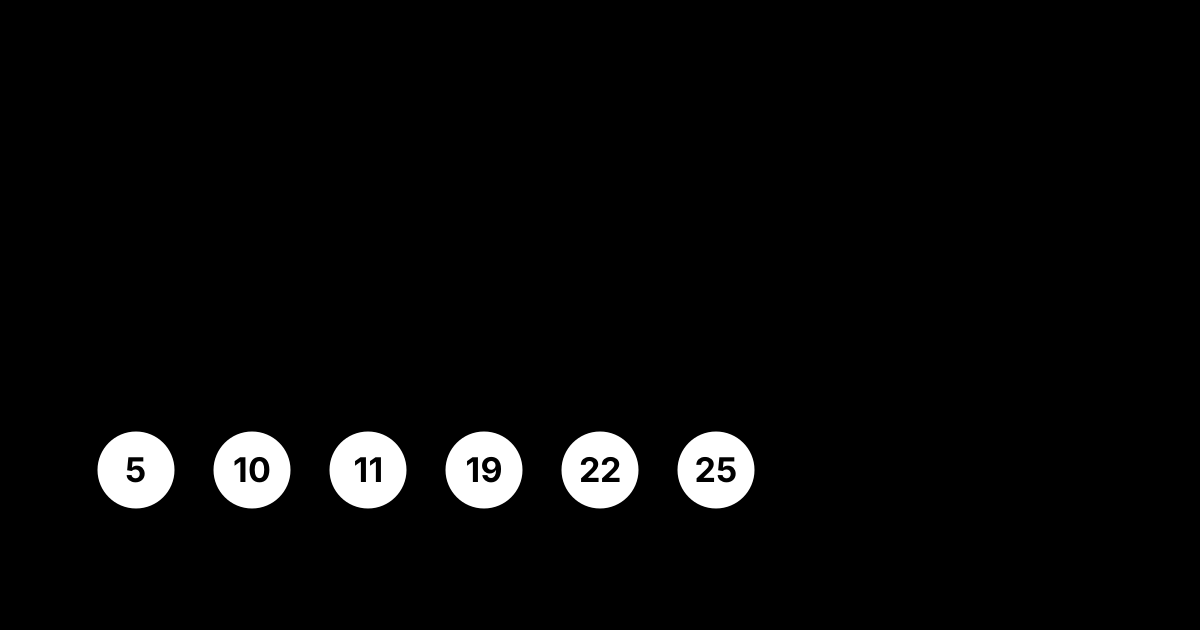
“keys” → K=11, E=5, Y=25, S=19
- 5, 10, 11, 19, 22, 25
Four letters, then 10 and 22 from doubling 5 and 11.
Among these six, 19 has come up 131 times and 5 has come up 118 times across 1,702 recorded Powerball draws. A record of past draws, not a forecast.
The counts below are historical Powerball records — what has been drawn, not what will be.
Numbers from this dream
- 5
- 10
- 11
- 19
- 22
- 25
How often these numbers have been drawn
Counts compiled from actual draw results.
Powerball
Compiled from 1,702 draws up to draw 2090. Counts cover main numbers only; the Powerball is tracked separately.
| Number | Times drawn | Share |
|---|---|---|
| 5 | 118 | |
| 10 | 124 | |
| 11 | 127 | |
| 19 | 131 | |
| 22 | 118 | |
| 25 | 122 |
Latest draw 2090 · September 7, 2026
- 15
- 19
- 28
- 39
- 56
- 3
Common questions
What does losing keys mean?
Access rather than possession. A lost key does not mean the thing is gone — it means you cannot currently reach it, which is usually closer to the actual feeling.
I dreamt of a key that did not fit.
The most frustrating version and a common one. Having the right object for the wrong lock tends to map onto effort applied in a place where it does not work, rather than onto lack of effort.
Does being given a key mean something different?
Yes, and it is worth separating. A key you were handed involves someone deciding to let you in. Who gave it to you generally matters more than what it opened.
Related dreams
-
 Airplane Dreams — Committed Until It Lands
-
 Book Dreams — Knowledge That Is Not Yours Yet
-
 Car Dreams — Who Is Driving Tells You Everything
-
 Clothes Dreams — Including the One Where You Are Naked
-
 Door Dreams — Open, Locked, or One You Did Not Notice
-
 Hospital Dreams — Admitting You Cannot Handle It Alone