Mountain Dreams — Climbing It Versus Looking At It
Standing at the base and standing on the summit are different dreams entirely. What the climb, the view and getting lost each signal.
Before reading anything into a mountain dream, answer one question: were you climbing, or were you looking?
Those are not variations of the same dream. They are different dreams.
The mountain as a goal with a shape
A mountain has height, a summit, and a route. That maps so cleanly onto how goals work that interpretation barely has to translate.
But mountains carry a second quality that matters: they are indifferent. A mountain does not care whether you make it. Interpretation picks this up too, which is why mountain dreams often carry a note of scale — of confronting something larger than your preferences.
Climbing
Climbing steadily. Engaged with a goal. Breathing hard means the pace exceeds current capacity, which is a note about pacing rather than about the goal.
Reaching the summit. Achievement. If the view was clear, the next thing is already visible.
Getting lost on the way up. The destination is clear and the route is not. Extremely common in careers where the next step is undefined.
Descending. Not failure. Returning to the base after expanding too fast is a normal and often deliberate move.
Looking
Seeing a mountain from a distance. You have not started. Whether it looked beautiful or heavy tells you whether this is aspiration or dread.
A mountain you cannot see the top of. Scale exceeding what you can currently plan for. Sometimes the honest response is to pick a smaller mountain first.
A mountain range. More than one large thing at once.
Dream books and numbers
Mountains appeared in the American dream books sold from the 1800s into the twentieth century, which listed dream symbols beside numbers for the street numbers game. We do not reprint them — the editions disagreed and none carried authority.
In Korea, Japan and Taiwan
Ambition is the English reading. In all three of these the mountain is also inhabited.
Korea. The mountain has a god. Sansin is depicted as a white-bearded old man with a tiger, and Buddhist temples build a separate shrine hall for him inside their own grounds — an older mountain religion absorbed rather than replaced. So getting lost on a mountain and meeting someone is a hopeful image in Korea, not a frightening one. Hiking is also a national pastime with its own dress code.
Japan. Mountains are entered, not conquered. Shugendō practitioners train on them, Mount Fuji was closed to women until 1872, and the word kamikakushi — spirited away — exists for people who go into the mountains and do not return. Reverence and real danger sit together.
Taiwan. Two thirds of the island is mountain, and the high peaks belong to indigenous nations whose origin stories are tied to specific mountains. Jade Mountain is a national symbol, and climbing it carries something closer to belonging than to achievement.
A resident god, a closed peak, an origin place. English mostly has the uphill battle.
The numbers
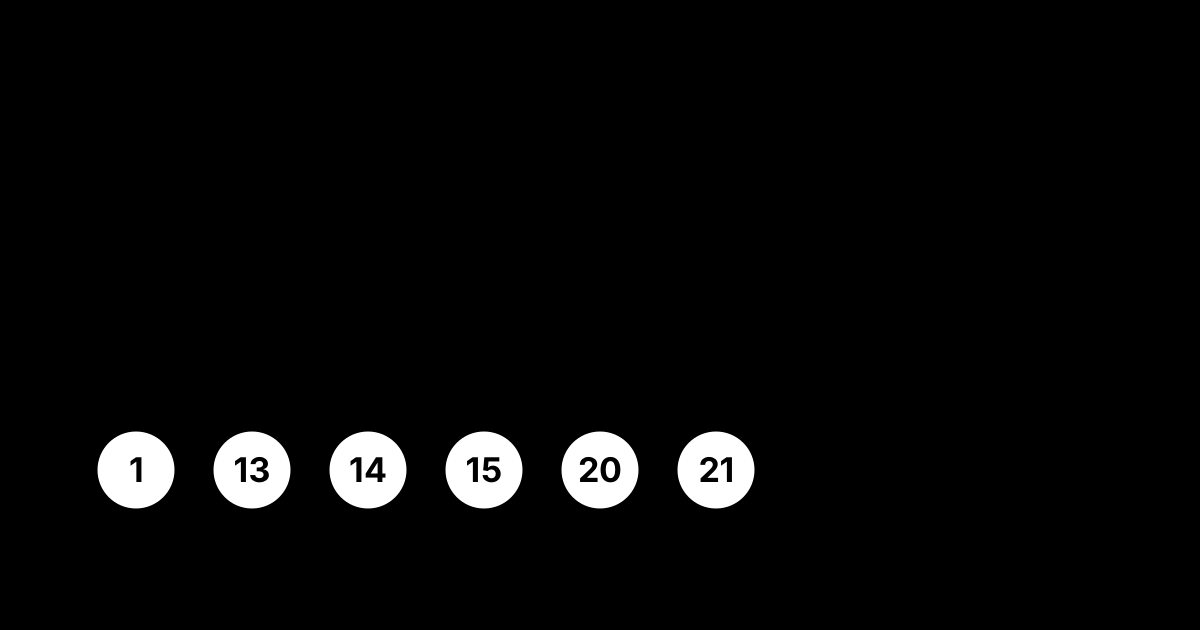
“mountain” → M=13, O=15, U=21, N=14, T=20, A=1, I=9, N=14
- 1, 13, 14, 15, 20, 21
A long word, so the rule takes letters in order until it has six. The final letters — the I and the repeated N — are not needed and drop out. Same procedure, run to its stopping point.
Among these six, 21 has come up 144 times and 13 has come up 108 times across 1,702 recorded Powerball draws. A record of past draws, not a forecast.
The counts below record real Powerball draws. Past frequency carries no information about the next draw.
Numbers from this dream
- 1
- 13
- 14
- 15
- 20
- 21
How often these numbers have been drawn
Counts compiled from actual draw results.
Powerball
Compiled from 1,702 draws up to draw 2090. Counts cover main numbers only; the Powerball is tracked separately.
| Number | Times drawn | Share |
|---|---|---|
| 1 | 116 | |
| 13 | 108 | |
| 14 | 123 | |
| 15 | 118 | |
| 20 | 113 | |
| 21 | 144 |
Latest draw 2090 · September 7, 2026
- 15
- 19
- 28
- 39
- 56
- 3
Common questions
Does reaching the summit matter?
Less than people expect. Arriving reads as a chapter closing; turning back partway reads as a decision still open. Neither is failure, and a climb that continued past waking is its own version.
What does getting lost on a mountain mean?
This is where traditions split hardest. English-language readings tend toward disorientation; in Korea, meeting someone while lost on a mountain is read as help arriving, because the mountain has a resident god.
Is a mountain always about ambition?
It is the default English reading, but not the only one available. In Japan and Taiwan the mountain is also sacred ground, and a dream that felt reverent rather than effortful is probably not about ambition at all.