Swimming Dreams — Handling the Water Instead of Being Handled
Swimming in clear water, against a current, out of your depth. The same element as a drowning dream, with the relationship reversed. Plus the numbers.
Swimming and drowning are the same element with the relationship reversed. In one you are managing the water. In the other it is managing you.
Water as feeling
In the English-language tradition, water stands for emotion and the unconscious — an association strong enough that it barely needs arguing. Deep water means deep feeling; murky water means feeling you cannot see into.
Swimming, then, is about competence with your own inner weather. Not avoiding it, not being submerged by it. Moving through it deliberately.
That is why these dreams tend to feel good even when the water is difficult. The activity itself implies capability.
By water
Clear water. Situations you can see into. The most favorable version.
Murky or dirty water. Working through something tangled. If you were still making progress, that is the useful detail.
Deep water, without fear. Scale you are equal to. Genuinely a strong dream.
Deep water, with fear. Out of your depth, and the phrase is not accidental — English already uses swimming for this.
Shallow water. Early stages. Nothing has really begun.
Open sea. Larger than a pool or a river, with no visible edge. If that felt vast rather than frightening, it reads as scope rather than danger.
By how you swam
Making steady progress. Straightforwardly good.
Swimming against the current. Effort against resistance. Whether you advanced or held position is the whole reading.
Swimming hard and going nowhere. The approach is not matched to the problem.
Getting out of the water. A stage completed.
Swimming with someone. Shared work. Matched pace matters more than speed.
Floating rather than swimming. A distinct dream. Rest, or passivity, depending on how it felt.
The same dream elsewhere
In Korea, water means wealth before it means emotion. Swimming in clear water reads as handling money and opportunity well, and the dream is treated as a favourable omen rather than as a description of emotional capacity.
There is also a note of caution underneath it. Korean folk tradition is full of water spirits and warnings about deep water, so swimming carries a trace of being somewhere you were told to be careful — which is not part of the American reading at all.
In Japan, swimming is read as riding a flow: whether you were moving with or against the situation. Neither wealth nor psychology dominates; the emphasis is on direction.
Money in Korea, direction in Japan, emotion in English.
In Korea, Japan and Taiwan
Whether people learn to swim at all differs, and that changes what the dream can mean.
Japan. Swimming is taught at school as a matter of course — most elementary schools have a pool, and summer lessons are standard. There is a traditional martial form of it, Nihon Eihō, developed for swimming in armour. So the Japanese swimming dream sits on real competence rather than on unfamiliarity.
Korea. The striking case is the haenyeo of Jeju — women who free-dive for shellfish with no air supply, working into their seventies. It is a recognised cultural institution and a matriarchal one. Swimming there is a job held by women, which is unusual anywhere in the world, and it gives the water an association with endurance rather than leisure.
Taiwan. The island was under martial law until 1987, and coastal access was restricted for decades. A generation grew up beside the sea without going in it, and swimming rates still reflect that. For older Taiwanese readers the water can be something they were kept away from.
Trained competence, a working profession, a coast once closed. English treats swimming as recreation and metaphor.
The numbers
“swimming” → S=19, W=23, I=9, M=13, M=13, I=9, N=14, G=7
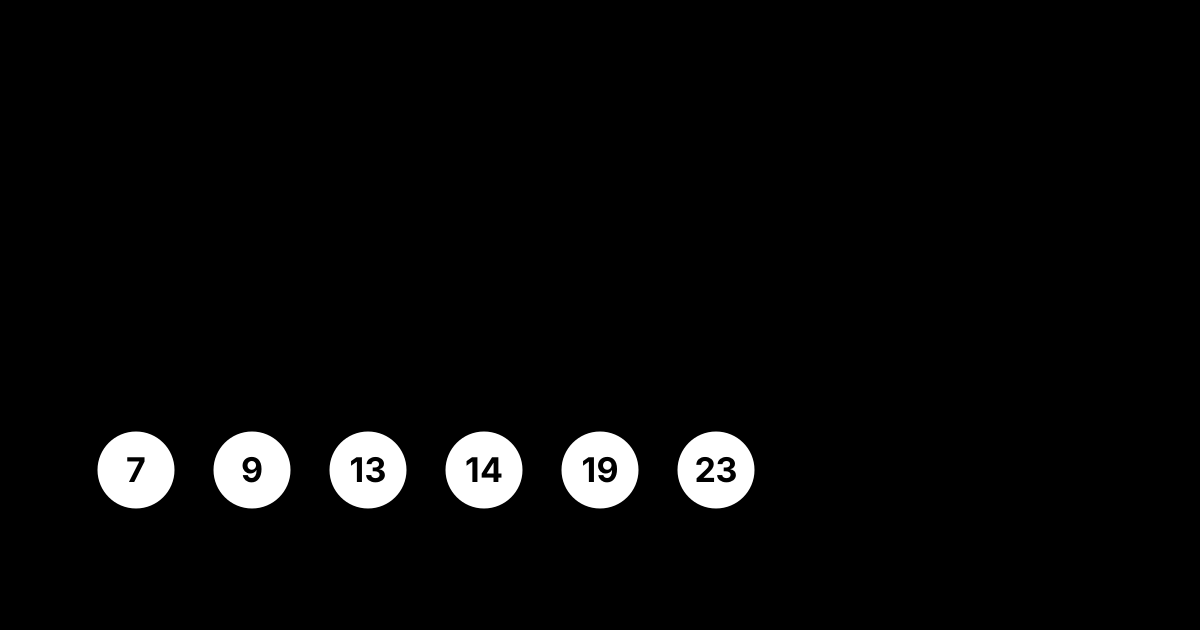
- 19, 23, 9, 13, 14, 7
Repeats collapse, leaving six distinct values.
Among these six, 23 has come up 146 times and 13 has come up 108 times across 1,702 recorded Powerball draws. A record of past draws, not a forecast.
The counts below record actual Powerball draws — a record of the past. Every draw is independent, and no number is ever due.
Numbers from this dream
- 19
- 23
- 9
- 13
- 14
- 7
How often these numbers have been drawn
Counts compiled from actual draw results.
Powerball
Compiled from 1,702 draws up to draw 2090. Counts cover main numbers only; the Powerball is tracked separately.
| Number | Times drawn | Share |
|---|---|---|
| 19 | 131 | |
| 23 | 146 | |
| 9 | 125 | |
| 13 | 108 | |
| 14 | 123 | |
| 7 | 120 |
Latest draw 2090 · September 7, 2026
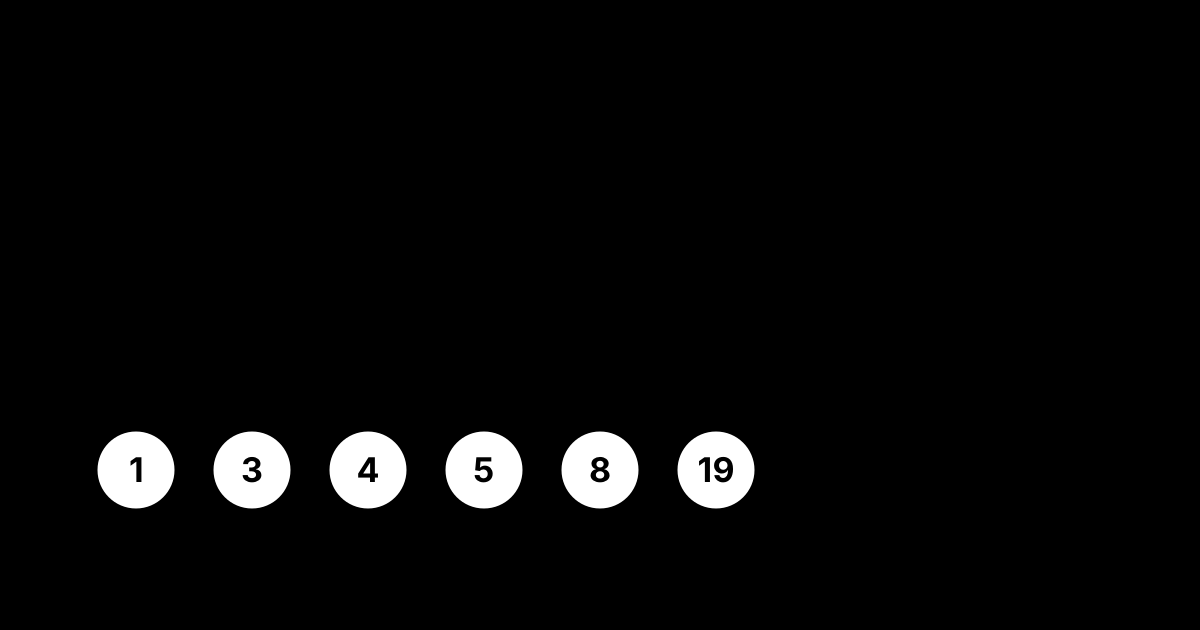
- 15
- 19
- 28
- 39
- 56
- 3
Common questions
Does struggling to swim mean I am overwhelmed?
Often, but check the water first. Struggling in calm water and coping easily in rough water are both common, and the mismatch between the conditions and your effort is usually where the meaning is.
What does swimming in deep water mean?
Depth is about what is underneath rather than about difficulty. Whether you could see the bottom, and whether that bothered you, tends to say more than how deep it was.
Is swimming with others different from swimming alone?
Yes, and it is worth separating. Alone is about your own capacity; with others it usually becomes about pace — keeping up, being left behind, or waiting.