Storm Dreams — Where You Were Standing
A storm is weather you cannot negotiate with. Whether you were sheltering, caught out, or watching it pass decides the reading.
A storm in a dream is one of the few images that reads the same way across almost every tradition: something large is happening and you did not cause it.
Weather you cannot negotiate with
Most dream symbols concern your own choices. Storms do not. They arrive, they are indifferent, and they pass.
That makes them the standard image for circumstances outside your control — a restructuring, an illness in the family, a market turning, a decision made several levels above you.
The interpretation is therefore not about the storm. It is about where you were standing in it.
Where you were
Sheltering, watching through a window. Braced and separated. You have made arrangements and they are holding.
Caught outside. Exposed with no arrangements. The dream is usually accurate about this.
Trying to keep going through it. Pushing against conditions rather than waiting them out. Sometimes necessary, often not.
Watching it approach. Anticipation. Reported before known events more than during them.
Watching it move away. Resolution. The best version.
Calm in the middle of it. The eye of the storm — a genuine phenomenon, and a genuine reading. A pause inside something that is not over.
Kinds of storm
Thunder and lightning. Sudden, loud, brief. Confrontations rather than conditions.
A tornado. Narrow and destructive. Something specific being torn out rather than everything being damaged. Frequently reported in American dreams for obvious geographic reasons.
Wind without rain. Pressure without substance — noise, rumor, agitation.
A long storm with no visible end. Less about an event than about a stretch that has gone on too long.
The same weather elsewhere
In Japan, typhoons arrive every year, so the reading is practical — a rough stretch with a known end. But Japan also has the kamikaze: the storm that sank an invading fleet, remembered for centuries as a disaster that turned out to be a rescue. That leaves a residue in the reading. A storm can clear things.
In Korea, typhoons are annual too, and the reading is similar, with one addition. Water means wealth in Korean interpretation, so what the storm brings matters as much as the storm. Water standing after the wind passes can read as things filling up.
In English, a storm is a trial to be endured — weather the storm is the standard phrase, and the emphasis falls on holding out. Inland, “storm” often means a tornado, which is a different shape of fear entirely: sudden, local, and not something you ride out.
Something that clears, something that fills, something you survive.
The numbers
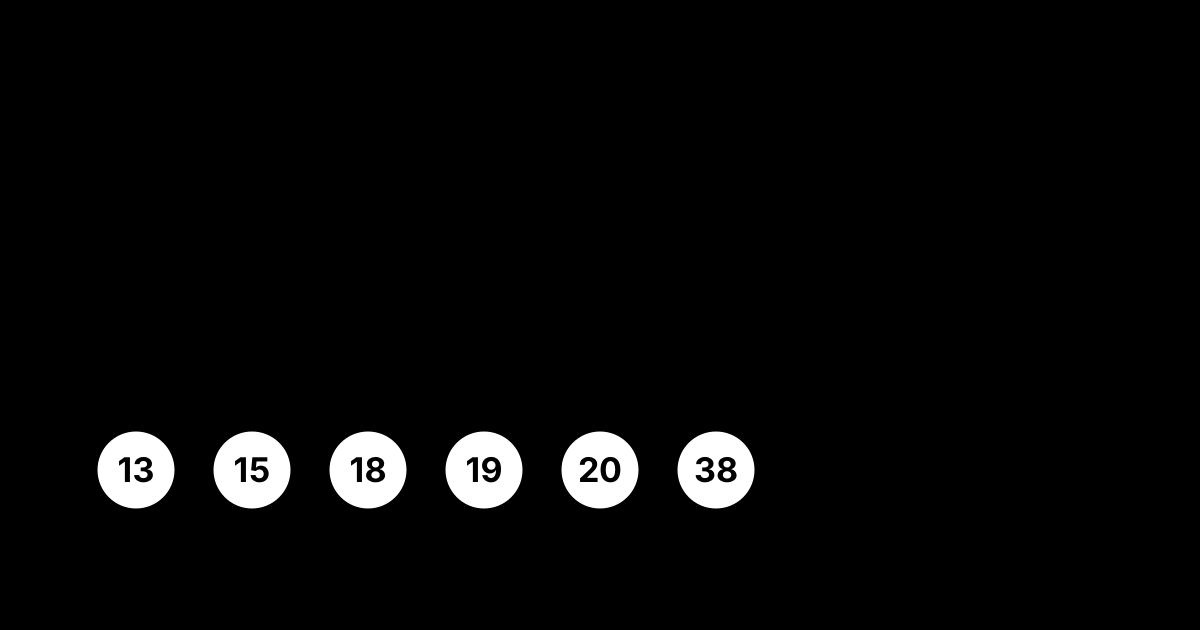
“storm” → S=19, T=20, O=15, R=18, M=13
- 13, 15, 18, 19, 20, 38
Five letters, plus 38 from doubling 19.
Of these six, 19 has come up 131 times across the 1,689 recorded Powerball draws in our data and 13 has come up 108 times. Independent draws; nothing carries over.
The counts below are historical Powerball records — a description of the past, nothing more.
Numbers from this dream
- 13
- 15
- 18
- 19
- 20
- 38
How often these numbers have been drawn
Counts compiled from actual draw results.
Powerball
Compiled from 1,702 draws up to draw 2090. Counts cover main numbers only; the Powerball is tracked separately.
| Number | Times drawn | Share |
|---|---|---|
| 13 | 108 | |
| 15 | 118 | |
| 18 | 126 | |
| 19 | 131 | |
| 20 | 113 | |
| 38 | 122 |
Latest draw 2090 · September 7, 2026
- 15
- 19
- 28
- 39
- 56
- 3
Common questions
Is a storm dream a warning?
It is better read as a description of a period than as a forecast of an event. The defining feature of a storm is that it ends — which separates it from an earthquake, where the ground itself moves. Where you were in the storm tells you where you are in the situation.
Does it matter whether I was indoors?
Yes, and it is the most useful detail. Watching from inside reads as being sheltered while conditions are rough elsewhere. Being caught outside reads as exposure to something you could have prepared for.
Do other cultures read storms as bad?
Not uniformly. Japan has the *kamikaze* story, where a storm that should have been a disaster became a rescue, and the sense that violent weather can clear things survives. Korean readings note that storms bring water, and water means wealth, so a flooded aftermath can read favourably.
Related dreams
-
 Earthquake Dreams — When the Assumption Moves
-
 Fire Dreams — Why the Frightening Ones Often Read Well
-
 Flower Dreams — Peak Season, and Its Shortness
-
 Moon Dreams — The Phase Is the Reading
-
 Mountain Dreams — Climbing It Versus Looking At It
-
 Ocean Dreams — Scale, Distance, and the Water You Cannot See Across