Walking Dreams — Progress at Your Own Speed
Walking a long road, uphill, with heavy legs. The one form of travel that runs entirely on your own effort. Plus the numbers, from a stated rule.
Walking dreams feel like nothing is happening. That is the information.
Nobody else is moving you
Trains run on someone else’s schedule. Planes commit you until they land. Walking is the only travel where the speed, the direction and the stopping are all yours — and so is the distance covered, which is the catch.
So a walking dream is about accumulation. Not a turning point; the thing you have been doing steadily. Whether that is satisfying or exhausting is usually clear from the dream itself.
English makes this easy to read, because the metaphor is already in the language: taking steps, one step at a time, a long road ahead, walking away. The dream and the idiom are the same picture.
By road
A wide, straight road. Visibility. You can see where this goes.
Uphill. Effort, but forward. Reaching the top suggests a stage is closing.
Downhill. Easier, with the risk of momentum you did not ask for.
A narrow track. A path few people take. Any loneliness in the dream is the content, not a side effect.
Mud, or broken ground. Difficulty, plainly. Still walking means still progressing.
An unfamiliar road is something new; a road you know is something continued.
By how you walked
Heavy legs, or not moving forward. Widely reported. It reads as conditions rather than willpower — the obstacle is usually external.
Barefoot. Exposure. Whether it hurt determines whether that is freedom or vulnerability.
Walking beside someone. A good sign, especially if your pace matched.
Looking back while walking. Attention still on what is behind.
Walking and never arriving. The sensation of open-ended work, rendered literally.
The same dream elsewhere
In Japan, there is a tradition where walking is itself the practice — the Shikoku pilgrimage, the Kumano trails, sacred mountain ascents. Arriving is not the point of the exercise, which allows a Japanese reading in which not arriving is still meaningful.
In Korea, walking dreams map more directly onto fortune: a light step means things are opening, a heavy one means they are stalling, and the road’s condition translates into a verdict.
The American reading has no equivalent of pilgrimage and no verdict. It reads walking as progress, and progress as something to be measured.
In Korea, Japan and Taiwan
Walking is not just transport in any of the three — it is a practice with a name.
Japan. The Shikoku pilgrimage runs eighty-eight temples over roughly 1,200 kilometres, and people still walk all of it. Aruki-henro — the walking pilgrim — is a recognised identity, and locals give food and lodging to strangers doing it. The walking is the observance; arriving is not the point.
Korea. The mountain hike is close to a national habit, complete with a recognisable dress code, and Jeju’s olle trails were built deliberately as a walking network. Walking is sociable there in a way it is not in English — it is something you do with people.
Taiwan. The Mazu pilgrimage walks for over a week and draws crowds in the hundreds of thousands. Households along the route feed the walkers. Walking is collective, and the dream of walking alone in a crowd reads differently against that background.
An observance, a sociable habit, a procession. In English it is mostly exercise and metaphor.
The numbers
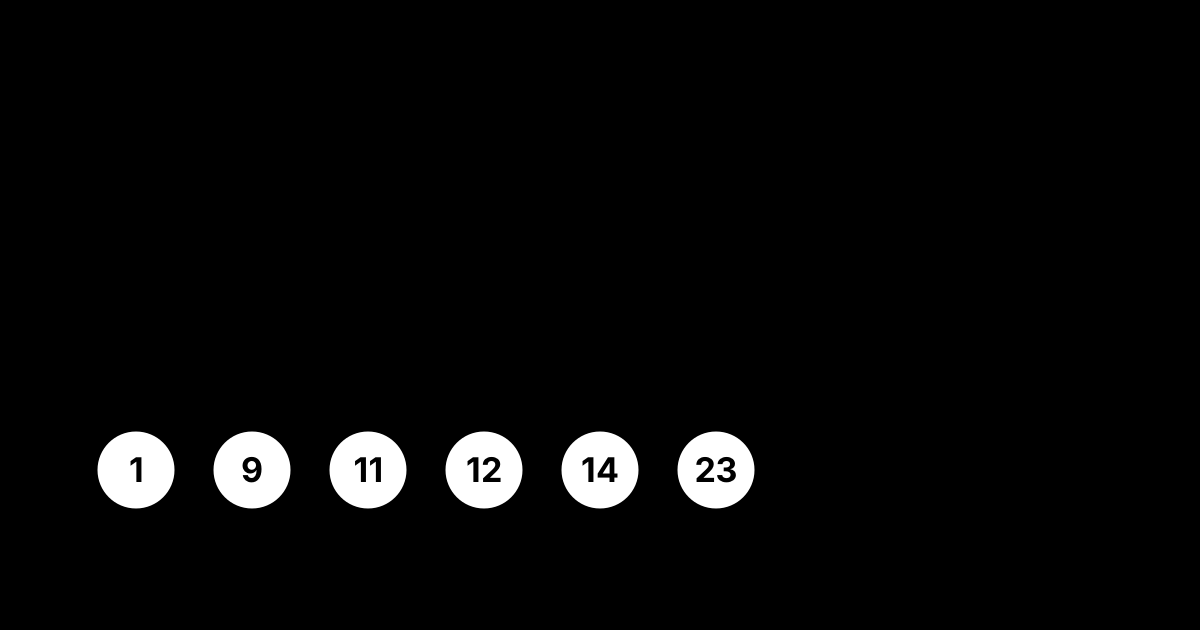
“walking” → W=23, A=1, L=12, K=11, I=9, N=14, G=7
- 23, 1, 12, 11, 9, 14
We take the first six distinct letter values.
Among these six, 23 has come up 146 times and 1 has come up 116 times across 1,702 recorded Powerball draws. Every draw is independent, and no number is ever due.
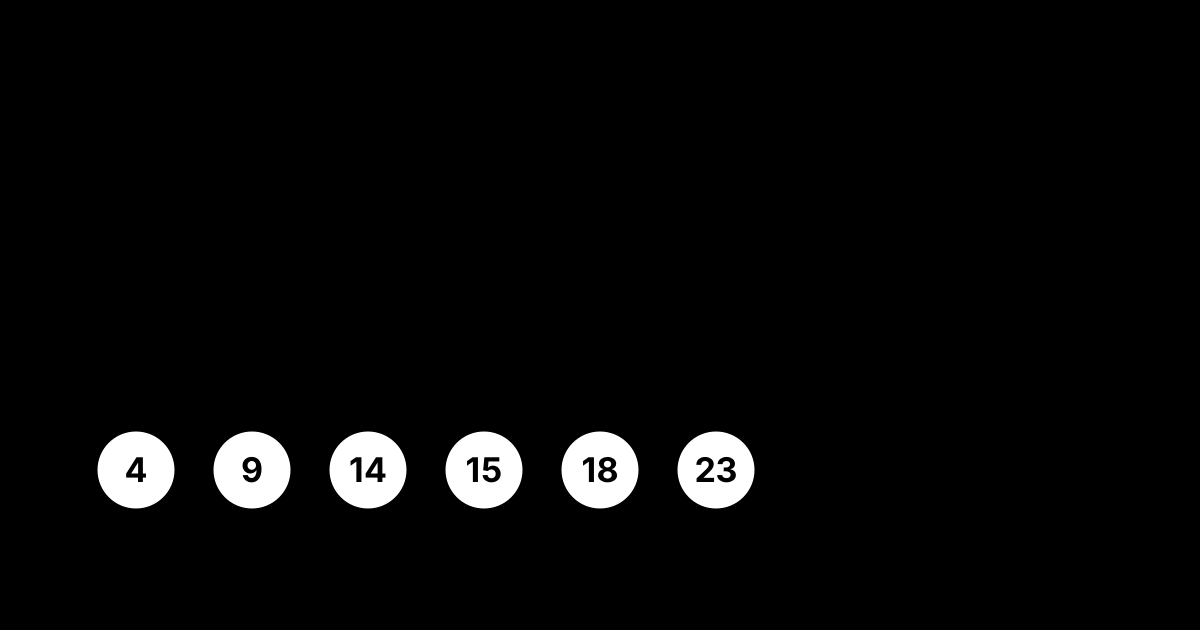
The counts below record actual Powerball draws — a record of the past. Every draw is independent, and no number is ever due.
Numbers from this dream
- 23
- 1
- 12
- 11
- 9
- 14
How often these numbers have been drawn
Counts compiled from actual draw results.
Powerball
Compiled from 1,702 draws up to draw 2090. Counts cover main numbers only; the Powerball is tracked separately.
| Number | Times drawn | Share |
|---|---|---|
| 23 | 146 | |
| 1 | 116 | |
| 12 | 133 | |
| 11 | 127 | |
| 9 | 125 | |
| 14 | 123 |
Latest draw 2090 · September 7, 2026
- 15
- 19
- 28
- 39
- 56
- 3
Common questions
Is walking in a dream significant if nothing happens?
The absence of event is the content. Walking is the one form of movement nobody else is doing for you, so a plain walking dream usually says something about pace rather than about destination.
What does walking barefoot mean?
Exposure, and the reading shifts by culture. In countries where shoes come off indoors, bare feet are ordinary and the dream needs a different reading than it does in English.
I was walking but not getting anywhere.
One of the most reported dream structures there is. Effort without progress fits many situations, which is exactly why it is a poor candidate for a specific message.