Snow Dreams — Quiet, or Buried
Snow covers and stops. Whether that reads as peace or as paralysis depends on the detail. Plus the numbers our letter rule produces.
People describe snow dreams as unusually quiet. Several report that the sound was gone.
Snow stops time
If rain carries things away, snow covers them. What is under it is hidden, and underneath, nothing moves.
That property fixes the interpretation. On the good side it reads as stillness and preservation. On the bad side, stalling and isolation. Same snow, opposite readings — which is why the details matter more here than in most dreams.
The favorable versions
Watching snow fall. Settled. A noisy period is ending.
A landscape that struck you as beautiful. Acceptance of the current situation, whatever it is.
First snow. Entering a new season, in the ordinary sense of a new phase.
Making tracks in fresh snow. Moving into territory nobody has worked yet.
The cautionary versions
Buried in snow. Unable to move. Carrying more than you can manage.
A blizzard. Neither the way forward nor the surroundings are visible. Proceeding without enough information.
Cold that was genuinely unpleasant. Distance from other people. Snow dreams attach easily to loneliness.
A road closed by snow. Something is genuinely preventing progress right now.
Snow melting
Read separately, and read well. What was stopped begins to move — the best version of this dream.
It also means what was hidden becomes visible again. Things put on hold have a way of coming back in this reading.
The same weather elsewhere
In Korea, snow that piles up is read as things accumulating, which puts it close to the wealth frame that water occupies. Clean, deep snow is favourable. There is also a folk association with good harvests — a heavy snow year meant a good year — that gives the image an economic edge English does not have.
In Japan, snow carries an aesthetic weight that is hard to translate. It belongs with the seasonal vocabulary of things that are beautiful because they do not last, and the reading emphasises stillness — a pause that is neither good nor bad, simply outside ordinary time.
In English, the dominant senses are purity and being snowed in. A blank white surface reads as a fresh start; being unable to leave reads as suspension imposed from outside.
Accumulation, stillness, a clean slate. Three readings of the same weather.
The numbers
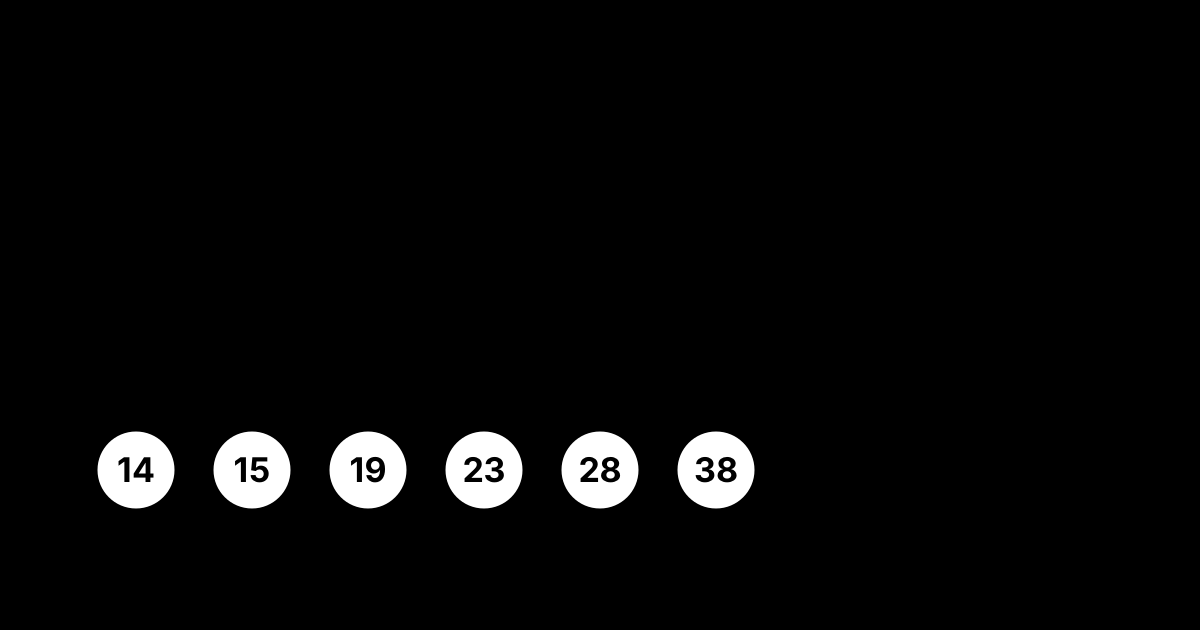
“snow” → S=19, N=14, O=15, W=23
- 14, 15, 19, 23, 28, 38
Four letters, plus 28 and 38 from doubling 14 and 19.
Of these six, 28 has appeared 150 times across the 1,689 recorded Powerball draws in our data and 15 has appeared 118 times. Past frequency does not change the next draw.
The counts below record actual Powerball draws. Every draw is independent of the last.
Numbers from this dream
- 14
- 15
- 19
- 23
- 28
- 38
How often these numbers have been drawn
Counts compiled from actual draw results.
Powerball
Compiled from 1,702 draws up to draw 2090. Counts cover main numbers only; the Powerball is tracked separately.
| Number | Times drawn | Share |
|---|---|---|
| 14 | 123 | |
| 15 | 118 | |
| 19 | 131 | |
| 23 | 146 | |
| 28 | 150 | |
| 38 | 122 |
Latest draw 2090 · September 7, 2026
- 15
- 19
- 28
- 39
- 56
- 3
Common questions
Is snow a good sign in a dream?
It depends on whether it was falling or already settled. Fresh snowfall reads as a pause and a clean surface; deep snow you cannot move through reads as being stuck. The temperature of the dream matters too — cold that felt peaceful and cold that felt punishing are different readings.
What does melting snow mean?
Something that was suspended starting to move again. It is generally read as favourable, though the melt reveals whatever was underneath, so it can also mark the point where a postponed problem becomes visible.
Does snow mean the same thing everywhere?
Not quite. Korean interpretation ties snow to accumulation and therefore to wealth, especially clean deep snow. Japanese readings emphasise stillness and the aesthetic of transience. English readings lean on purity and on being snowed in.
Related dreams
-
 Earthquake Dreams — When the Assumption Moves
-
 Fire Dreams — Why the Frightening Ones Often Read Well
-
 Flower Dreams — Peak Season, and Its Shortness
-
 Moon Dreams — The Phase Is the Reading
-
 Mountain Dreams — Climbing It Versus Looking At It
-
 Ocean Dreams — Scale, Distance, and the Water You Cannot See Across