Snake Dreams — What They Mean and the Numbers Behind Them
What a snake has meant to Freud, to Jung, and to the old American dream books — plus our letter-rule numbers and how often they have been drawn.
You wake up and the snake is still there behind your eyes — the shape of it, the way it moved. Snake dreams tend to stay with people longer than almost anything else the sleeping mind produces.
The two readings you will run into
Ask a psychologist and you will get one of two answers, depending on who trained them.
Freud read the snake as a phallic symbol, full stop. Anxiety about sex, desire, or the body. It is the reading most people have heard, and it is also the one modern clinicians lean on least.
Jung went further back. For him the snake belonged to a much older layer of the mind, tied to instinct and to transformation — the animal that sheds its skin and continues. In Jungian terms a snake dream often arrives when something in your life is ending in order to become something else. Not a threat. A hinge.
The Jungian reading has aged better, partly because it matches what people actually report. Snake dreams cluster around job changes, moves, breakups, recoveries.
What the situation tells you
Bitten by a snake. The moment most people remember. It reads as a change that arrives suddenly rather than gradually. Where you were bitten matters to some interpreters — hands for work, feet for the ground you stand on.
A snake you are watching, not touching. Something you are aware of and have not engaged with yet.
Killing the snake. Refusing the change. Not necessarily wrong, but worth knowing that is what you did.
A snake shedding its skin. The clearest version of the Jungian reading. Something is finishing and the next form is already underneath.
Many snakes. Options, or obligations, arriving at once.
How East Asia reads the same dream
Worth knowing, because it is almost the reverse.
In Korea, snakes are lucky. Traditional houses were said to host an eop-guryeongi — a resident serpent that guarded the household’s wealth. If it left, the family’s fortunes were expected to decline with it. The snake is a guardian, not a threat.
In Japan, the white snake is the messenger of Benzaiten, the deity of wealth and the arts. Her day in the calendar is the Day of the Snake, and buying a wallet on that day is still considered good practice.
So the animal that English tradition made into the deceiver of Eden is, a few thousand miles east, the thing that keeps money in your house. Neither reading is more correct. Each grew out of how people actually lived alongside the animal — in Japan and Korea, snakes ate the rodents that would otherwise have taken the rice.
Where the dream book tradition comes in
Here is a piece of American history that most people no longer know.
From the mid-1800s through the mid-1900s, dream books were sold on street corners and in corner stores across the United States. Titles like Aunt Sally’s Policy Player’s Dream Book listed dream symbols alongside three-digit numbers. Readers used them to pick numbers for “policy” — the illegal numbers game that ran in cities long before state lotteries existed. The books were especially widespread in Black communities, where the numbers game was both a livelihood and one of the few available forms of informal banking.
That tradition is why a page like this one exists at all. Dreams and numbers have been tied together in American life for well over a century.
Our numbers, and how we get them
We should be straight with you about one thing: we are not reproducing those old dream books. Their number assignments varied from publisher to publisher and often contradicted each other. Quoting one as though it were authoritative would be inventing authority that never existed.
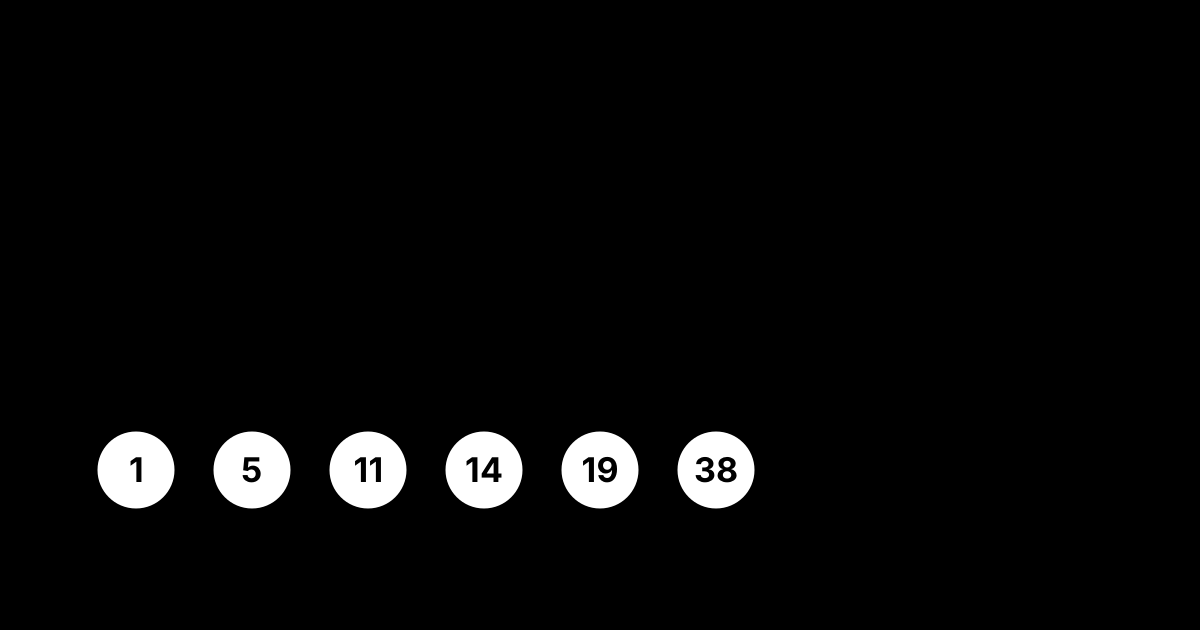
Instead we use a rule you can check yourself. Take the word, convert each letter to its place in the alphabet, and use those as the starting numbers. Where we need more, we take multiples and wrap them back into the Powerball range.
“snake” → S=19, N=14, A=1, K=11, E=5
- 1, 5, 11, 14, 19, 38
Five letters give five numbers; 38 is 19 doubled. Run it yourself and you will land in the same place. That is the whole point — the numbers come from a stated procedure, not from us deciding what feels lucky.
Of these six, 19 has appeared 131 times across the 1,689 recorded Powerball draws in our data and 1 has appeared 116 times. Neither figure affects the next draw.
The table below shows how often each of these has actually come up in Powerball. It is a record of what happened, not a forecast. Every draw is independent, and no number is “due.”
Numbers from this dream
- 1
- 5
- 11
- 14
- 19
- 38
How often these numbers have been drawn
Counts compiled from actual draw results.
Powerball
Compiled from 1,702 draws up to draw 2090. Counts cover main numbers only; the Powerball is tracked separately.
| Number | Times drawn | Share |
|---|---|---|
| 1 | 116 | |
| 5 | 118 | |
| 11 | 127 | |
| 14 | 123 | |
| 19 | 131 | |
| 38 | 122 |
Latest draw 2090 · September 7, 2026
- 15
- 19
- 28
- 39
- 56
- 3
Common questions
Is a snake dream always a warning?
In English-language interpretation it usually reads as threat or as something hidden, largely because of Eden and of Freud. But that is one inheritance among several. In Japan a white snake is a messenger of a goddess of wealth, and in Korea a snake in the house was the guardian of the family's fortune. The animal is not the warning; the tradition is.
What does being bitten by a snake mean?
The English reading is betrayal or a sudden problem. Korean tradition reads being bitten as money arriving, which is close to the opposite. Which reading fits is partly a question of which culture you are standing in — and partly of how you felt when you woke.
Does the colour of the snake matter?
It matters most in the East Asian readings. White is the significant colour there, tied to wealth and to divine messengers. English-language interpretation pays more attention to what the snake did than to what it looked like.