Dreams of Dead Relatives — A Visit, or a Haunting?
English tradition treats the returning dead as a problem. Korea and Japan treat it as scheduled. The same dream, two entirely different frames.
A grandmother appears. A father is standing there, saying nothing. These dreams stay with people for years, and how you read them depends enormously on which tradition you inherited.
The English frame: something has gone wrong
In English-language storytelling, the dead return because something is unresolved. A murder unavenged, a will unfulfilled, a burial botched. The ghost is a problem, and the story ends when it is settled or escaped.
That structure sits underneath a lot of English-language dream interpretation without being examined. People wake from these dreams asking what does it want, which already assumes the visit is irregular.
The East Asian frame: this is scheduled
Both Korea and Japan operate on the opposite assumption.
Korea has jesa — memorial rites held on the anniversary of a death and at major holidays, with food prepared and set out for the ancestor. Japan has Obon, when families light welcoming fires so the dead can find their way home, and send them off again days later.
In both, the dead coming back is the normal state of affairs. There is a calendar for it. A grandmother in a dream is not an anomaly requiring explanation; she is early, or she has something to say.
Korean tradition goes further and ties these dreams directly to fortune. Josang-kkum — ancestor dreams — are among the most consequential dreams a person can have, and stories about an ancestor supplying lottery numbers circulate widely enough to be a recognizable genre.
Japanese reading is gentler on the money question but equally comfortable with the visit itself.
Reading yours
Setting the frames aside, the details that carry meaning are consistent.
They said something. What they said matters less than how you felt while they were speaking. That feeling is the retrievable part.
They looked well. Read favorably. Whatever you are doing is holding.
They looked troubled, or were searching for something. Something unattended — in Korean practice this reads directly as a neglected obligation, often a grave or a rite.
They gave you something. The strongest positive version in both East Asian readings.
They said nothing and only watched. Wait. Do not force the decision.
You ate together. Read very well. Sharing food means being on the same side.
In Taiwan specifically
Taiwan keeps the most visible version of the scheduled frame, and it has details the general East Asian description leaves out.
The shrine is in the house. Many households still keep a gongma altar with ancestral tablets and offer incense daily. An ancestor dream there does not come from nowhere — it comes from someone you lit incense for this morning.
The dead are sorted. During the seventh lunar month families make offerings to their own ancestors and, separately, to the hao xiong di — the wandering dead nobody tends. A dream figure is read differently depending on which of the two it seems to be.
Burial is not the end. In the practice of jiangu, bones are exhumed after several years, cleaned, and placed in an urn. A dream about an ancestor’s grave can therefore be about an obligation still pending, not a closed chapter.
Incense this morning, a sorting of the dead, a reburial still to come. None of those layers exist in the English frame.
The numbers
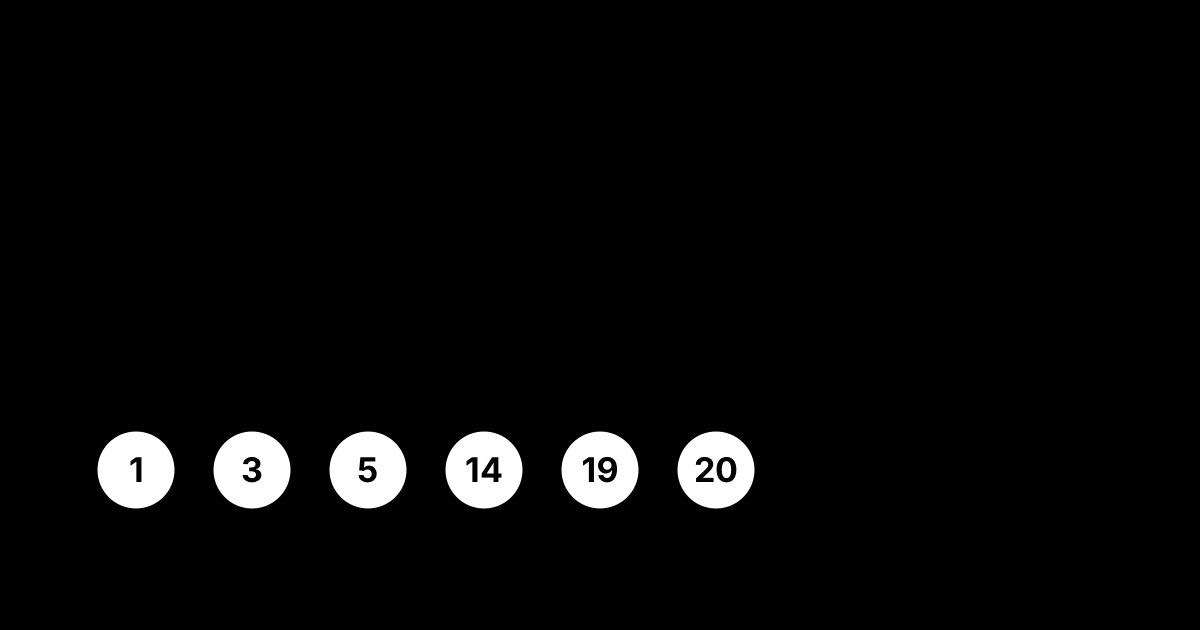
“ancestor” → A=1, N=14, C=3, E=5, S=19, T=20
- 1, 3, 5, 14, 19, 20
Six distinct letters taken in order.
Among these six, 3 has come up 138 times and 20 has come up 113 times across 1,702 recorded Powerball draws. A record of past draws, not a forecast.
These dreams move people, which is exactly when it is worth restating: the numbers come from a stated rule, not from the dream. They guarantee nothing. The table below is a historical record.
Numbers from this dream
- 1
- 3
- 5
- 14
- 19
- 20
How often these numbers have been drawn
Counts compiled from actual draw results.
Powerball
Compiled from 1,702 draws up to draw 2090. Counts cover main numbers only; the Powerball is tracked separately.
| Number | Times drawn | Share |
|---|---|---|
| 1 | 116 | |
| 3 | 138 | |
| 5 | 118 | |
| 14 | 123 | |
| 19 | 131 | |
| 20 | 113 |
Latest draw 2090 · September 7, 2026
- 15
- 19
- 28
- 39
- 56
- 3
Common questions
Is dreaming of an ancestor a warning?
In English-language readings the dream is usually treated as grief or unfinished business. In East Asian traditions it is closer to a visit, and what the ancestor said matters more than the fact that they appeared.
Why do these dreams cluster around certain dates?
Anniversaries, festivals and family gatherings put the person back into your attention. That clustering is exactly what the East Asian calendars formalise, which is why the dreams feel scheduled there.
What if the ancestor seemed angry?
It tends to stay with people, but it does not have to be read as blame. More often the dream is carrying something you are uneasy about yourself, placed in a familiar face.
Related dreams
-
 Dreams About Babies — New Things, Not Necessarily Children
-
 Celebrity Dreams — The Role, Not the Person
-
 Couple Dreams — Watching a Partnership From Outside
-
 Deity Dreams — Being Addressed by Something Larger
-
 Dreams About Friends — Usually About Who You Were Then
-
 Ghost Dreams — What Has Not Been Put Down