River Dreams — There Is a Far Bank
A river differs from the sea in one way that decides everything: you can see the other side. Crossing, turning back, and water that is too deep.
Rivers and oceans look like the same symbol and are not. One difference settles it: you can see the far bank of a river.
An ocean dream is about scale and the unknown. A river dream is about a boundary with a known other side — you can see where you are going and you are still on this side.
Crossing as commitment
English carries this in its idioms without needing folklore. Crossing the Rubicon. Burning your bridges. Sold down the river. Rivers mark decisions that are hard to reverse.
The classical version is the Styx — the river the dead cross, with a ferryman who takes payment. That image survives in English culture as metaphor rather than belief, but it is why crossing water carries a note of finality.
Situation by situation
Crossing successfully. Passing a threshold. Reported around moves, job changes, and separations — anything you cannot easily undo.
Turning back midway. The decision is being deferred.
Water too deep to cross. Conditions are not ready. Read as timing rather than as failure.
Clear water flowing. Things are progressing. The movement is the point.
A river in flood. More than you accounted for — though clear floodwater carries a secondary reading of increase rather than damage.
A dried riverbed. Flow stopped. Something that was moving has halted.
Pulling something from the water. Gain from the current. Read favorably.
Someone standing on the far bank. Distance between you and that person.
Where the image is heaviest
In Japan, crossing a river carries a specific weight: the Sanzu River, which the dead cross. The association is widely enough held that Japanese interpretation has to actively distinguish “crossing a river” from any omen about death — and does, reading it as irreversible transition instead.
Korean tradition has Gongmudohaga, one of the oldest surviving Korean poems, about a man who drowned crossing a river against warning. Rivers there mark the line between here and elsewhere.
In Korea, Japan and Taiwan
Three separate traditions arrived at the same image — a river you cross once — from unconnected sources.
Japan. The Sanzu no Kawa is the river the dead cross, and the fare is six coins, which is why they were placed with the body. The crossing point depends on how you lived.
Korea. The phrase in daily use is crossing the Jordan, taken from the Bible and now completely naturalised as a way of saying someone has died. Separately the Han River carries an entirely different weight — postwar reconstruction was named after it, so the country’s recovery story is a river story.
Taiwan. The temple layer is different again: rivers are where the drowned remain, and during the seventh lunar month people avoid the water because those spirits are said to look for a substitute. The river is not a boundary to cross but a place to stay away from.
English-speaking countries have Styx, also with a coin for the ferryman, and crossing the Rubicon for the decision you cannot undo.
Two of these four cultures independently invented paying the ferryman. That is worth noticing.
The numbers
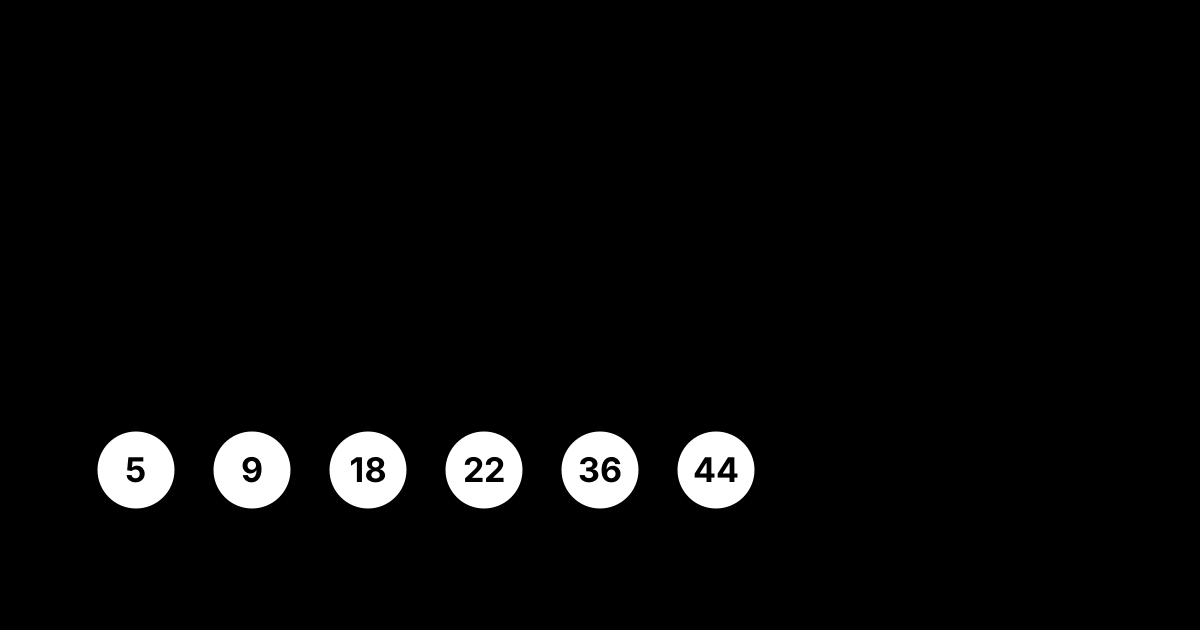
“river” → R=18, I=9, V=22, E=5
- 5, 9, 18, 22, 36, 44
The repeated R collapses to four distinct letters; 36 and 44 come from doubling.
Among these six, 36 has come up 142 times and 5 has come up 118 times across 1,702 recorded Powerball draws. Every draw is independent, and no number is ever due.
The counts below are historical Powerball records — what has been drawn, not what will be.
Numbers from this dream
- 5
- 9
- 18
- 22
- 36
- 44
How often these numbers have been drawn
Counts compiled from actual draw results.
Powerball
Compiled from 1,702 draws up to draw 2090. Counts cover main numbers only; the Powerball is tracked separately.
| Number | Times drawn | Share |
|---|---|---|
| 5 | 118 | |
| 9 | 125 | |
| 18 | 126 | |
| 22 | 118 | |
| 36 | 142 | |
| 44 | 136 |
Latest draw 2090 · September 7, 2026
- 15
- 19
- 28
- 39
- 56
- 3
Common questions
Does crossing a river mean something ending?
The association exists in several traditions, but it is not the only reading. Whether you reached the other side, turned back, or never intended to cross tends to matter more than the crossing itself.
What does muddy or fast water mean?
Visibility and control, and they are separate questions. Clear water that is not moving and muddy water that is flowing are different dreams, and it is worth separating which one you had.
Is standing on the bank without crossing significant?
It is its own version and a common one. Standing at the edge fits a decision not yet made. What was on the other side, and whether anyone was waiting, are the useful details.
Related dreams
-
 Earthquake Dreams — When the Assumption Moves
-
 Fire Dreams — Why the Frightening Ones Often Read Well
-
 Flower Dreams — Peak Season, and Its Shortness
-
 Moon Dreams — The Phase Is the Reading
-
 Mountain Dreams — Climbing It Versus Looking At It
-
 Ocean Dreams — Scale, Distance, and the Water You Cannot See Across