Pig Dreams — Why English Reads Them the Opposite Way From Korea
In English a pig means excess and uncleanness. In Korea the same dream is the luckiest thing you can see. Both readings are old. Plus the numbers.
Look up a pig dream in an English dream dictionary and you will get some version of greed, gluttony, or mess. Look up the same dream in Korea and you will be told to buy a lottery ticket.
Both traditions are old. Both are internally consistent. They just started from different places, and the gap between them is more interesting than either answer on its own.
The English-language reading
Three separate streams feed into it.
Scripture. The pig is listed among unclean animals in Leviticus, and the parable of the prodigal son uses feeding pigs as the bottom of a man’s fall. That framing traveled through centuries of European moral writing and settled into the language.
The language itself. English gives no quarter here — pig out, hog the road, pigsty, pigheaded, sweating like a pig. Almost every idiomatic use is negative, and dream interpretation absorbs idiom whether or not it means to.
The dream book era. American dream books, sold from the 1800s onward, generally kept the negative reading and paired pigs with themes of appetite and waste.
So in English interpretation, a pig usually points at something you are consuming past the point of use — spending, eating, working, scrolling. Not a moral failing so much as a rate problem.
Situation by situation
A clean, healthy pig. The exception. Even hostile traditions concede that a well-kept pig means prosperity — the animal was, after all, stored wealth on the hoof.
A pig in filth. The standard negative version. Something has been allowed to accumulate.
Being chased by a pig. An appetite you have been avoiding facing.
A sow with piglets. Fertility and increase. This version reads well in almost every tradition, English included.
Slaughtering a pig. Converting something stored into something usable. Read as harvest rather than violence.
A pig running into your house. The version that splits the traditions most sharply. In English it tends to mean an appetite that has come indoors and made itself at home. Ask whether you let it in or it pushed past you.
A thin or sickly pig. Stored value running down. Less about loss than about something you assumed would keep that has not been maintained.
Feeding a pig. You are the one supplying the appetite. Worth asking what you keep topping up and whether it still gives anything back.
A pig that escapes. Something you were holding in reserve slipping out of reach. Whether you chased it matters more than whether you caught it.
The part worth knowing
In Korea the pig dream is the lucky dream — the one people actually act on. The reasoning is concrete: the Korean word for pig, dwaeji, sits close to don, the word for money; pigs bear large litters; and a pig’s head is still set out at ceremonies asking for prosperity.
Japan splits the difference in an unexpected way. The twelfth zodiac sign is written with the same character, but in Japan it refers to the wild boar, not the domestic pig. So the Japanese reading is about recklessness and forward momentum — chototsu-mōshin, charging straight ahead — and has almost nothing to do with money.
One animal, three traditions, three unrelated meanings. If a pig dream left you uneasy, it may be worth knowing that a large part of the world would read it as the best news you could get.
The Taiwanese layer
Taiwan sits much closer to Korea than to Japan here, but it gets there by its own route.
The zodiac pig is a pig. Unlike Japan, the twelfth sign in Taiwan is the domestic animal, so the zodiac and the farmyard point the same way instead of pulling apart.
The pig is written into the word for home. The character for jia, family or household, is a roof with a pig beneath it. A farm family without a pig was a family without savings, and that sense of the pig as the household’s reserve still colours how a pig dream is read.
Dream dictionaries lean positive. Popular guides published under the name of the Duke of Zhou, the traditional patron of Chinese dream reading, tend to treat a fat pig or a pig entering the house as money coming in, and a pig running off as a chance slipping away.
So a Taiwanese reader and an American reader can wake from the same dream with opposite moods, and neither is misreading it.
The numbers
Letters become alphabet positions; multiples fill out the set.
“pig” → P=16, I=9, G=7
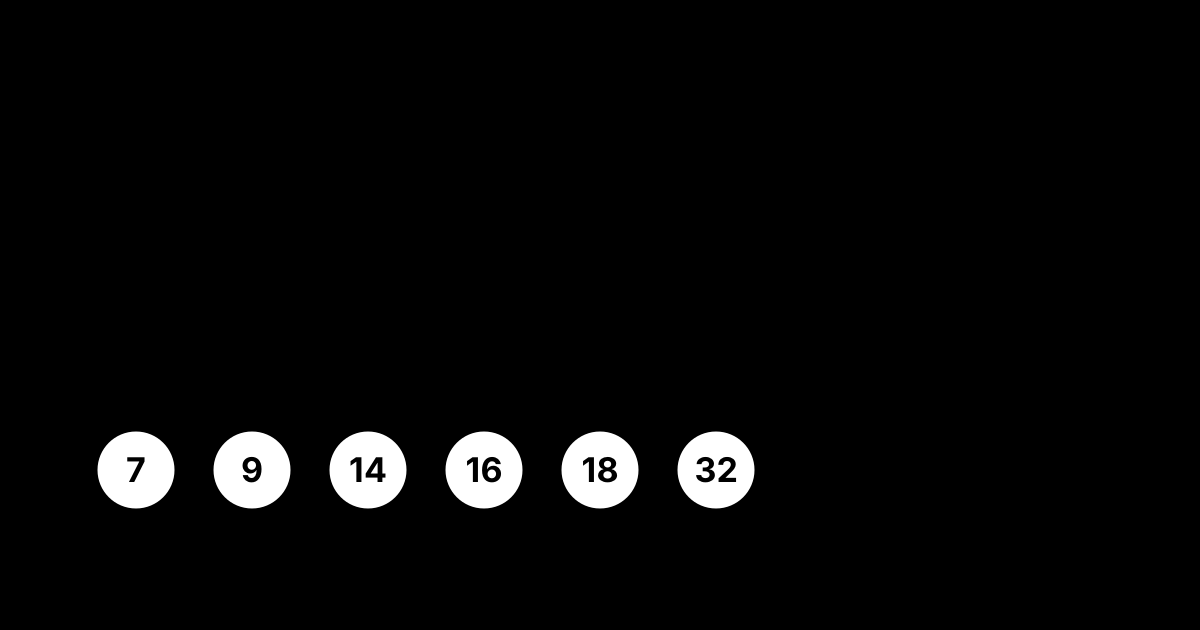
- 7, 9, 14, 16, 18, 32
Three letters give three numbers; 14, 18 and 32 are those doubled. Reproducible against the alphabet in well under a minute.
Among these six, 32 has come up 142 times and 7 has come up 120 times across 1,702 recorded Powerball draws. Past draws only, nothing about the next one.
The counts below record actual Powerball draws. They are a record of the past. Every draw is independent, and no reading of any dream changes that.
Numbers from this dream
- 7
- 9
- 14
- 16
- 18
- 32
How often these numbers have been drawn
Counts compiled from actual draw results.
Powerball
Compiled from 1,702 draws up to draw 2090. Counts cover main numbers only; the Powerball is tracked separately.
| Number | Times drawn | Share |
|---|---|---|
| 7 | 120 | |
| 9 | 125 | |
| 14 | 123 | |
| 16 | 133 | |
| 18 | 126 | |
| 32 | 142 |
Latest draw 2090 · September 7, 2026
- 15
- 19
- 28
- 39
- 56
- 3
Common questions
Is dreaming about pigs good or bad?
It depends on the state of the pig and on which tradition you read it through. A clean, well-kept pig reads as stored value almost everywhere, while a pig in filth leans toward excess in English readings.
What does it mean when a pig runs into your house in a dream?
In Korean and Taiwanese readings this is one of the best versions, value arriving where you live. In English readings it points more at an appetite that has moved into daily life, so notice whether you welcomed it.
Why do some people buy lottery tickets after a pig dream?
Because in Korea and Taiwan the pig is tied to money through farming history and wordplay. That is a cultural habit, not evidence, and the numbers here come only from a spelling rule.