Ghost Dreams — What Has Not Been Put Down
Ghosts in dreams tend to be about the unfinished rather than the dead. What the figure wants, and why that question is the useful one.
Ghost dreams frighten people out of proportion to what they usually mean.
A ghost is something that did not finish
Across traditions, the ghost is defined by incompletion. It stays because something was left undone — a wrong unaddressed, a rite unperformed, a goodbye not said.
Dream interpretation takes that structure directly. A ghost in a dream tends to point at something in your own life that has not been concluded. Not necessarily grief. Often something much smaller and older.
What the figure was doing
Trying to tell you something. The most common version. Whether or not you recall the words, what you felt while listening is the part worth keeping.
Following you. Something you are moving away from that has not been settled.
Silent and watching. Awareness without demand. Often reported during periods of reflection rather than distress.
Someone you knew who has died. This is a different category and should be read separately — see the death dream entry. Most traditions read it as memory doing work, not as contact.
A ghost in a specific place. The location usually matters more than the figure. Childhood homes are common, and they carry their own reading.
Not frightened at all. Reported more often than people expect, and read favorably — something being put down rather than raised.
A note on cultural distance
English-language ghost stories run on the haunting: the figure is a problem to be resolved or escaped.
East Asian traditions treat the returning dead differently. Korean and Japanese practice both include regular rites for ancestors — jesa, obon — where the dead are expected to come back, and the visit is normal rather than alarming. A grandmother appearing in a dream reads in Korea as a message worth attending to, not as a haunting.
If your dream felt more like a visit than a scare, that reading may fit it better than the English one.
The structural difference is worth stating plainly, because it changes what you would even try to do about it.
In English, a ghost attaches to a place. The phrase is haunted house — the building is the subject, not the person. The remedies follow from that: banish it, cleanse the property, or move.
In Japan, the ghost has a reason. Classical ghost stories give the figure a grievance — something unresolved, something unsaid, someone improperly mourned. The dead are not trespassing; they have business. Notably, the story often ends with the fear intact rather than with the grievance settled.
In Korea, the reason is not just present but is the point of the story. The gwisin carries han — accumulated unresolved grief — and the standard narrative is a magistrate hearing the case and setting it right. The ghost wants to be heard.
So the three cultures disagree about what a ghost is for. In English it is something to remove. In Japan it is something with a claim. In Korea it is someone with a case to make. Only the English version has no expectation that you would listen.
The numbers
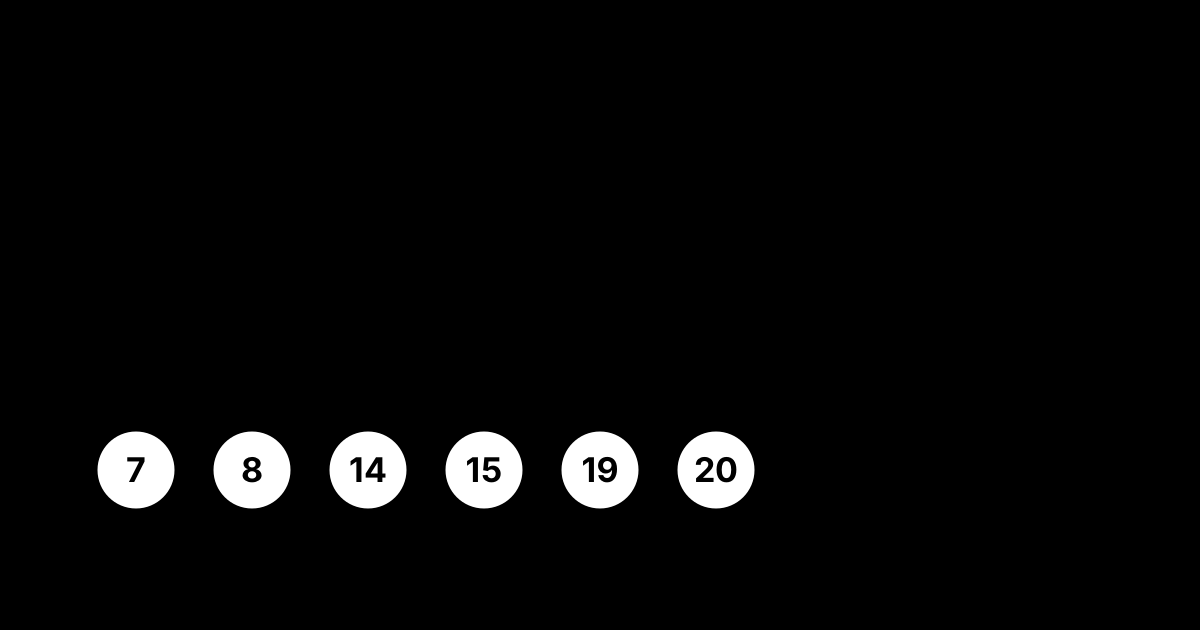
“ghost” → G=7, H=8, O=15, S=19, T=20
- 7, 8, 14, 15, 19, 20
Five letters, plus 14 from doubling 7.
Among these six, 19 has appeared 131 times across the 1,689 recorded Powerball draws in our data and 20 has appeared 113 times. Frequency in the past does not carry forward.
The counts below are historical Powerball records. They describe what has happened and nothing else.
Numbers from this dream
- 7
- 8
- 14
- 15
- 19
- 20
How often these numbers have been drawn
Counts compiled from actual draw results.
Powerball
Compiled from 1,702 draws up to draw 2090. Counts cover main numbers only; the Powerball is tracked separately.
| Number | Times drawn | Share |
|---|---|---|
| 7 | 120 | |
| 8 | 129 | |
| 14 | 123 | |
| 15 | 118 | |
| 19 | 131 | |
| 20 | 113 |
Latest draw 2090 · September 7, 2026
- 15
- 19
- 28
- 39
- 56
- 3
Common questions
Is a ghost dream a warning?
English-language interpretation does not treat it as one. The figure generally stands for something unfinished rather than something approaching. What the ghost was doing — speaking, following, simply present — carries more information than the fact that it appeared.
I was paralysed and could not move or speak. What was that?
That combination is worth separating from the interpretation. Being unable to move while aware of a presence is a documented experience at the edge of sleep, and it produces a figure in the room reliably enough that cultures across the world have named it. If the dominant memory is pressure on the chest and frozen limbs, the imagery does not need decoding.
The ghost was someone I know who has died. Is that different?
Yes, and most traditions handle it separately. In Japan and Korea a dead relative appearing is read within the ancestor framework rather than as a haunting — the expression and what was said become the material. The English default of "haunting" fits poorly here.
Related dreams
-
 Dreams of Dead Relatives — A Visit, or a Haunting?
-
 Dreams About Babies — New Things, Not Necessarily Children
-
 Celebrity Dreams — The Role, Not the Person
-
 Couple Dreams — Watching a Partnership From Outside
-
 Deity Dreams — Being Addressed by Something Larger
-
 Dreams About Friends — Usually About Who You Were Then